Verified Docket
Case notes
Study notes for Miranda v. Arizona: the case card, facts, procedure, holding, reasoning, separate opinions, what came next and study questions. Sources are listed at the end of the page.
Case card
| Field | Record |
|---|
| Full name | Miranda v. Arizona, decided with Vignera v. New York, Westover v. United States and California v. Stewart |
| Citation | 384 U.S. 436, 86 S. Ct. 1602, 16 L. Ed. 2d 694 (1966) |
| Court | Supreme Court of the United States, on certiorari to the Supreme Court of Arizona (No. 759), the New York Court of Appeals (No. 760), the Ninth Circuit (No. 761) and the Supreme Court of California (No. 584) |
| Docket numbers | Nos. 759, 760, 761 and 584, October Term 1965; certiorari granted, 382 U.S. 924, 925, 937 |
| Argued | February 28 – March 1, 1966 (Nos. 759–761); February 28 – March 2, 1966 (No. 584) |
| Decided | June 13, 1966 |
| Vote | 5–4 |
| Majority | Chief Justice Warren, joined by Justices Black, Douglas, Brennan and Fortas |
| Dissents | Clark (dissenting in Nos. 759–761, concurring in the result in No. 584); Harlan, joined by Stewart and White; White, joined by Harlan and Stewart |
| Counsel (No. 759) | John J. Flynn argued for Miranda, with John P. Frank on the brief; Gary K. Nelson, Assistant Attorney General, argued for Arizona |
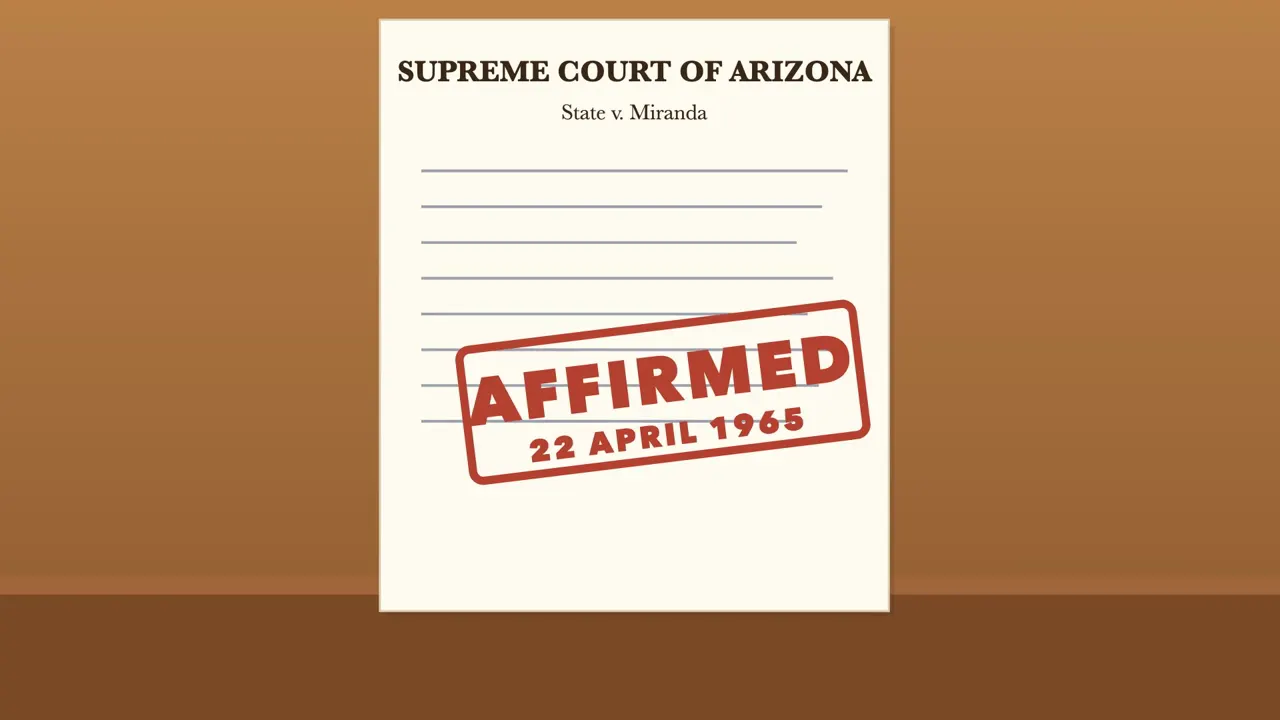
| Below | State v. Miranda, 98 Ariz. 18, 401 P.2d 721 (1965) (No. 1394, April 22, 1965), reversed |
| After remand | State v. Miranda, 104 Ariz. 174, 450 P.2d 364 (1969) (No. 1802, February 6, 1969; rehearing denied March 11, 1969): second conviction affirmed |
| Outcome | Statements from custodial interrogation are inadmissible unless the prosecution shows warnings (or a fully effective equivalent) and a knowing, intelligent waiver. Miranda, Vignera and Westover win reversals; the California reversal in Stewart is affirmed. |
Companion cases below: People v. Vignera, 15 N.Y.2d 970, 207 N.E.2d 527 (1965), remittitur amended, 16 N.Y.2d 614, 209 N.E.2d 110 (1965); Westover v. United States, 342 F.2d 684 (9th Cir. 1965); People v. Stewart, 62 Cal. 2d 571, 400 P.2d 97 (1965).
Later cases in this pack: Dickerson v. United States, 530 U.S. 428 (2000) (No. 99-5525; argued April 19, decided June 26, 2000; 7–2; Rehnquist, C.J.; Scalia, J., dissenting with Thomas, J.). Vega v. Tekoh, 597 U.S. 134 (2022) (No. 21-499; argued April 20, decided June 23, 2022; 6–3; Alito, J.; Kagan, J., dissenting with Breyer and Sotomayor, JJ.). Vega pin cites are to the official slip opinion ("slip op.").
The story in 150 words
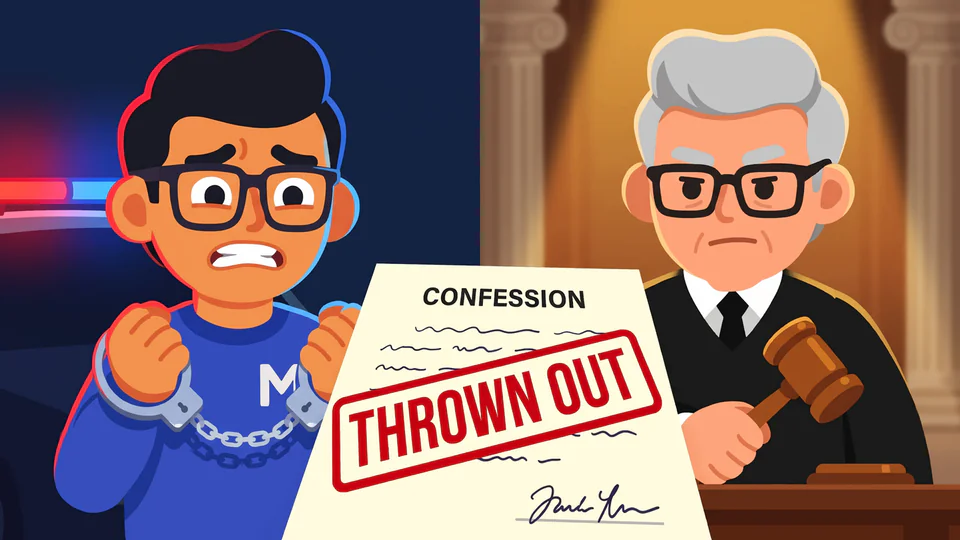
On March 13, 1963, Phoenix police questioned Ernesto Miranda about the kidnapping and rape of an eighteen-year-old woman ten days earlier. After about two hours in "Interrogation Room No. 2" he signed a confession. A typed paragraph at the top said he made it "with full knowledge of my legal rights," but no one had told him he could have a lawyer with him during questioning. The confession was used at trial, a jury convicted him, and the Arizona Supreme Court affirmed. In 1966 the U.S. Supreme Court reversed by 5–4. It held that before police question someone in custody, they must warn the person of the right to remain silent and the right to a lawyer, appointed if necessary. Arizona then tried Miranda again without the confession. A jury convicted him a second time, largely on the testimony of the woman he lived with.
Facts
The crime. On March 3, 1963, the complaining witness, "a girl eighteen years of age", had been working in the concession stand at the Paramount Theatre in downtown Phoenix. After getting off a bus on her way home, she was seized, forced into a car, driven away and raped (98 Ariz. at 21–22). Her first police report described the car as an "old model, possibly 1955 Chevrolet or Ford" (104 Ariz. at 176). About a week later her brother-in-law saw a similar car, identified it as a 1953 Packard, and gave police a plate number. The plate led to a car registered to Mrs. Twila Hoffman, and from there to Miranda (104 Ariz. at 177).
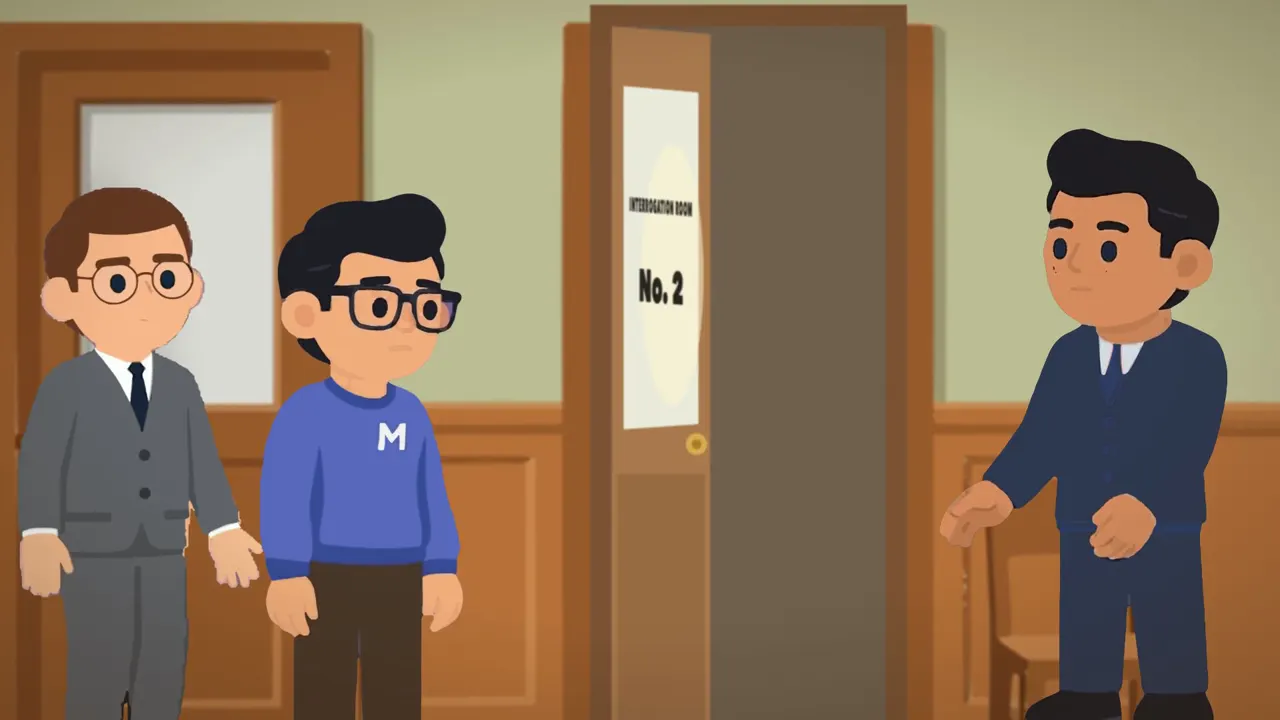
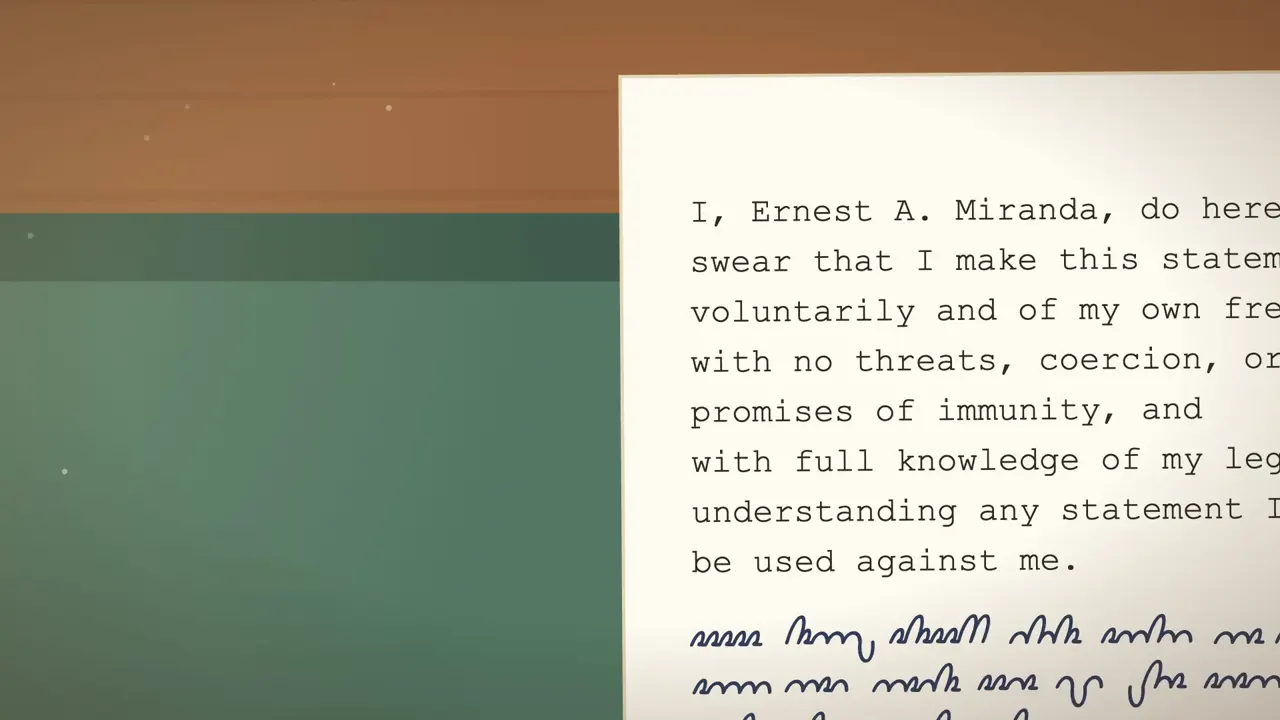
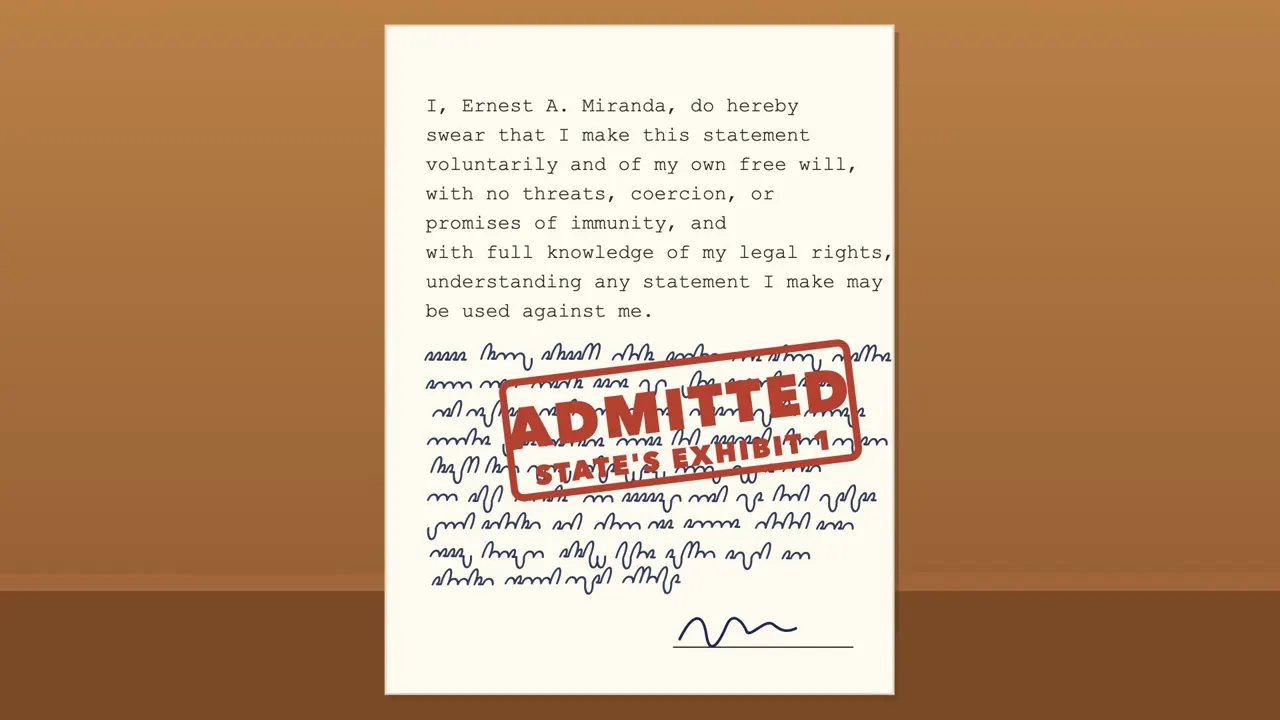
The questioning. The Supreme Court found that on March 13, 1963, Miranda "was arrested at his home and taken in custody to a Phoenix police station. He was there identified by the complaining witness. The police then took him to 'Interrogation Room No. 2' of the detective bureau" (384 U.S. at 491). "The officers admitted at trial that Miranda was not advised that he had a right to have an attorney present" (id.). Two hours later the officers came out with a signed confession. A typed paragraph at its top said it was made "with full knowledge of my legal rights, understanding any statement I make may be used against me." (id. at 491–492). One officer testified that he read that paragraph to Miranda: "Apparently, however, he did not do so until after Miranda had confessed orally" (id. at 492 n.67). The statement was "partly typed and partly in his own handwriting" (98 Ariz. at 22). The officers were Detective Carroll Cooley and Officer Wilfred M. Young, who signed the statement as a witness (98 Ariz. at 25–26, 28).
A different account on the retrial record. The 1969 Arizona opinion says the officers asked Miranda to come to the station, and "The defendant acceded to this request and went with the officers at about 11:30 a.m. This was on March 13, 1963." (104 Ariz. at 177). The victim could not positively identify him in a lineup. Officers then told him she had identified him, and he confessed (id. at 177–178). "At 1:30, in the afternoon, the defendant was formally arrested for kidnapping, rape and failure to register as an ex-convict." (id. at 178).
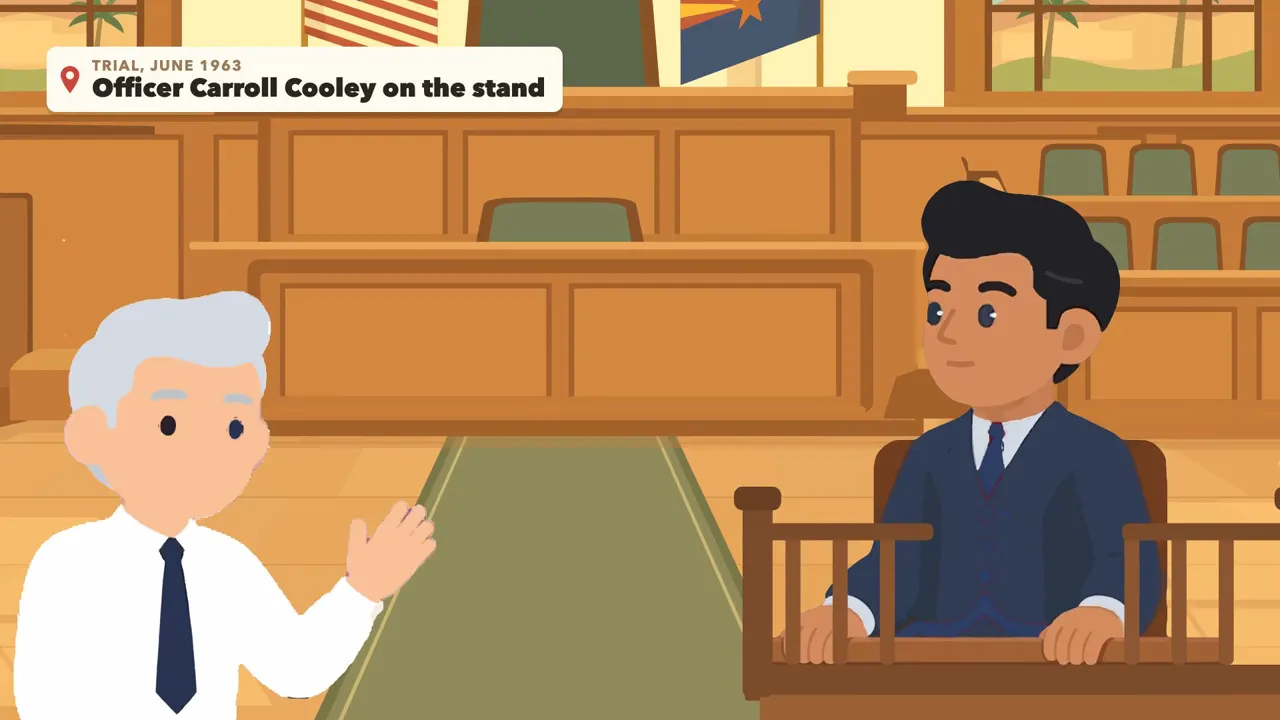
The first trial. Trial was held June 20, 1963 (98 Ariz. at 25). The written confession came in over defense objection, and the officers described the oral confession. Miranda was convicted of kidnapping and rape and sentenced to 20 to 30 years on each count, to run concurrently (384 U.S. at 492; 98 Ariz. at 21).
The companions (384 U.S. at 493–499). Vignera: questioned by a detective and then by an assistant district attorney, whose transcript "contains no statement of any warnings" (at 493); sentenced to 30 to 60 years. Westover: questioned by Kansas City police overnight, then by FBI agents in the same station, who warned him only at the start of their own session; sentenced to 15 years on each of two counts, consecutively. Stewart: questioned nine times over five days in Los Angeles; sentenced to death; the California Supreme Court reversed.
Procedural history
- Maricopa County Superior Court (June 1963). Convicted and sentenced to 20–30 years on each count, concurrently (98 Ariz. at 21, 25).
- Arizona Supreme Court, 98 Ariz. 18 (April 22, 1965). Affirmed (McFarland, J.). The court read Escobedo as turning on a denied request for counsel and held: "We hold that a confession may be admissible when made without an attorney if it is voluntary and does not violate the constitutional rights of defendant." (98 Ariz. at 36). Alvin Moore appeared for Miranda (id. at 21).
- U.S. Supreme Court, 384 U.S. 436 (June 13, 1966). Reversed, 5–4: "the judgments of the Supreme Court of Arizona in No. 759, of the New York Court of Appeals in No. 760, and of the Court of Appeals for the Ninth Circuit in No. 761 are reversed. The judgment of the Supreme Court of California in No. 584 is affirmed." (384 U.S. at 499).
- Retrial. The confession was not used. The judge excluded the victim's lineup identification as a "fruit" of the illegal confession but admitted Mrs. Hoffman's testimony that Miranda had confessed to her during a jail visit on March 16, 1963 (104 Ariz. at 179). Miranda was convicted and again sentenced to 20–30 years (uscourts.gov).
- Arizona Supreme Court, 104 Ariz. 174 (February 6, 1969; rehearing denied March 11, 1969). Affirmed (Molloy, J., Court of Appeals, sitting). The court held that "there was a sufficient 'break in the stream of events' between the confession to the police and the confession to Mrs. Hoffman, to justify the court in admitting this testimony." (104 Ariz. at 183). Frank, Flynn and Paul G. Ulrich appeared for Miranda (id. at 176).
The question presented
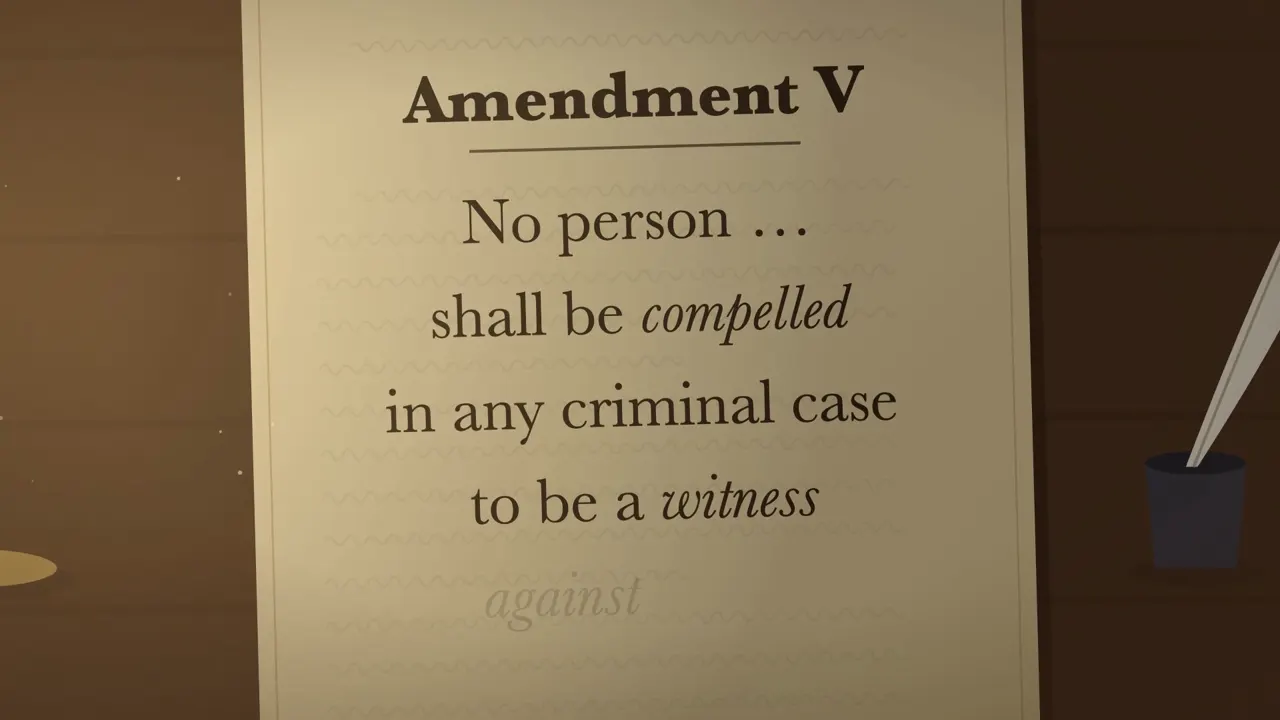
The cases concern "the admissibility of statements obtained from an individual who is subjected to custodial police interrogation and the necessity for procedures which assure that the individual is accorded his privilege under the Fifth Amendment to the Constitution not to be compelled to incriminate himself" (384 U.S. at 439). In short: does the privilege against compelled self-incrimination apply in the police station, and if so, what must police do before a confession can be used?
The holding and the rule
"the prosecution may not use statements, whether exculpatory or inculpatory, stemming from custodial interrogation of the defendant unless it demonstrates the use of procedural safeguards effective to secure the privilege against self-incrimination." — 384 U.S. at 444
"By custodial interrogation, we mean questioning initiated by law enforcement officers after a person has been taken into custody or otherwise deprived of his freedom of action in any significant way." — 384 U.S. at 444
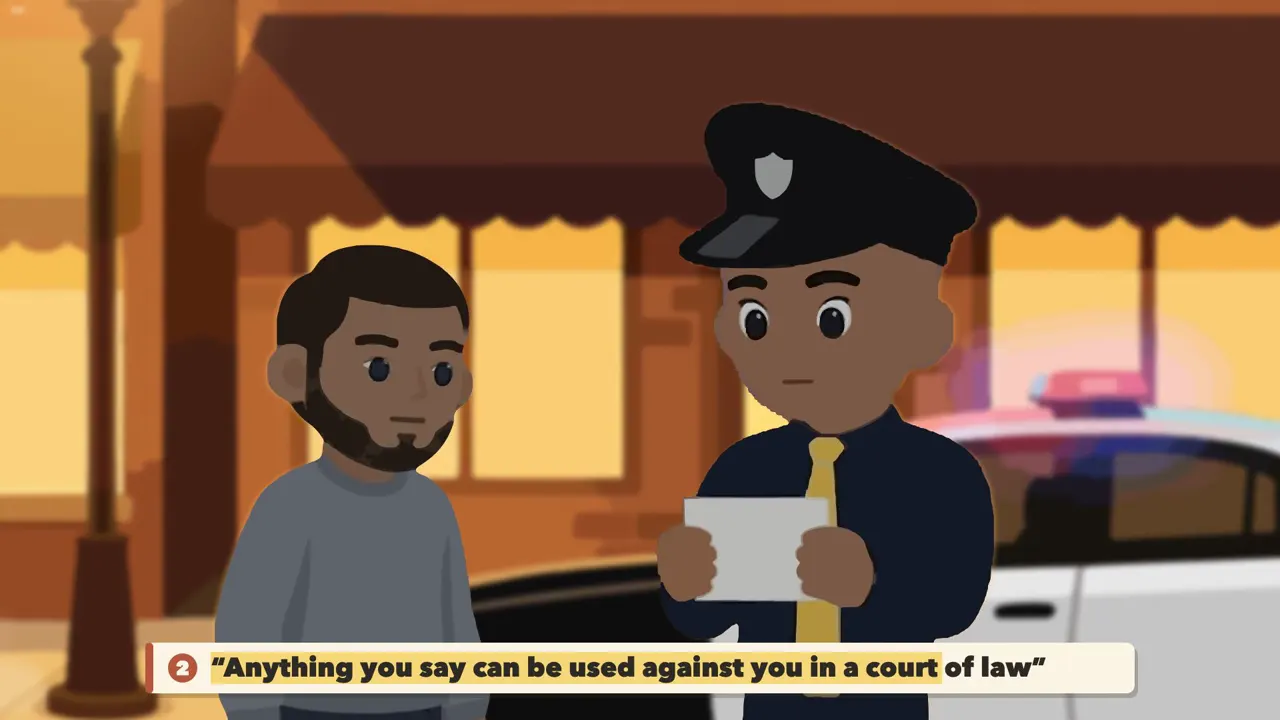
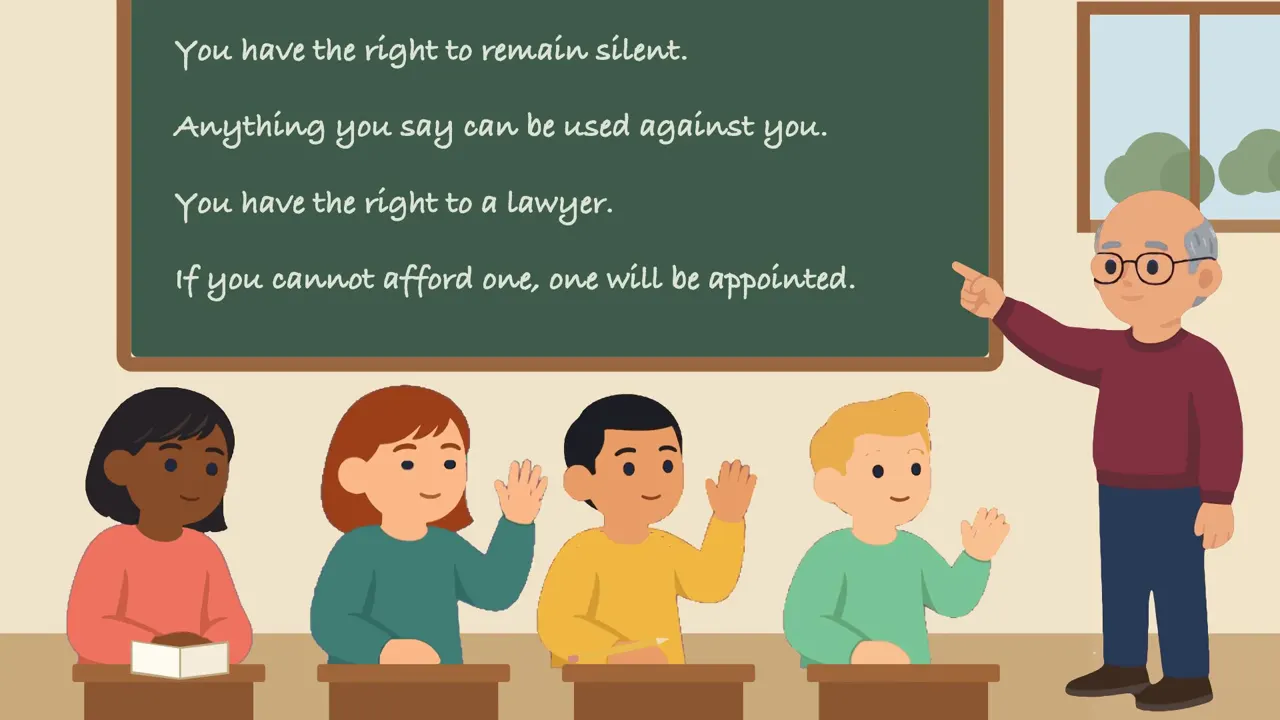
"He must be warned prior to any questioning that he has the right to remain silent, that anything he says can be used against him in a court of law, that he has the right to the presence of an attorney, and that if he cannot afford an attorney one will be appointed for him prior to any questioning if he so desires." — 384 U.S. at 479
"But unless and until such warnings and waiver are demonstrated by the prosecution at trial, no evidence obtained as a result of interrogation can be used against him." — 384 U.S. at 479
Waiver. "The defendant may waive effectuation of these rights, provided the waiver is made voluntarily, knowingly and intelligently." (at 444). The government bears "a heavy burden" (at 475), and "a valid waiver will not be presumed simply from the silence of the accused after warnings are given or simply from the fact that a confession was in fact eventually obtained." (id.).
Invocation. If the person indicates "that he wishes to remain silent, the interrogation must cease." (at 473–474). "If the individual states that he wants an attorney, the interrogation must cease until an attorney is present." (at 474).
Applied to Miranda. "The mere fact that he signed a statement which contained a typed-in clause stating that he had 'full knowledge' of his 'legal rights' does not approach the knowing and intelligent waiver required to relinquish constitutional rights." (at 492).
The reasoning, step by step
1. Custody brings its own pressure. "Again we stress that the modern practice of in-custody interrogation is psychologically rather than physically oriented." (384 U.S. at 448). The four cases shared "incommunicado interrogation of individuals in a police-dominated atmosphere, resulting in self-incriminating statements without full warnings of constitutional rights." (at 445). "This atmosphere carries its own badge of intimidation. To be sure, this is not physical intimidation, but it is equally destructive of human dignity." (at 457).
2. The privilege reaches the station house. The privilege rests on "the respect a government . . . must accord to the dignity and integrity of its citizens." (at 460). "without proper safeguards the process of in-custody interrogation of persons suspected or accused of crime contains inherently compelling pressures which work to undermine the individual's will to resist and to compel him to speak where he would not otherwise do so freely." (at 467).
3. Building on Escobedo. The Court reaffirmed Escobedo v. Illinois, 378 U.S. 478 (1964) (384 U.S. at 442). Escobedo had held, on its facts, "that when the process shifts from investigatory to accusatory" the accused must be allowed to consult his lawyer (378 U.S. at 492).
4. A bright line. A suspect "must first be informed in clear and unequivocal terms that he has the right to remain silent." (384 U.S. at 467–468). Courts will not guess what a suspect already knew, because a warning is "a clearcut fact" (at 469). And "the right to have counsel present at the interrogation is indispensable to the protection of the Fifth Amendment privilege under the system we delineate today." (at 469). Indigent suspects must be told that a lawyer will be appointed (at 472–473).
5. Room for reform. "Our decision in no way creates a constitutional straitjacket which will handicap sound efforts at reform, nor is it intended to have this effect." (at 467). Other procedures that are "at least as effective" would do (id.).
6. Limits. "In dealing with statements obtained through interrogation, we do not purport to find all confessions inadmissible." (at 478). "General on-the-scene questioning as to facts surrounding a crime or other general questioning of citizens in the fact-finding process is not affected by our holding." (at 477). "Volunteered statements of any kind are not barred by the Fifth Amendment and their admissibility is not affected by our holding today." (at 478).
7. Workable for police. Citing FBI practice and the experience of other countries, the Court concluded that the rule "should not cause an undue interference with a proper system of law enforcement" (syllabus, 384 U.S. at 437; discussion at 479–491).
Dissents
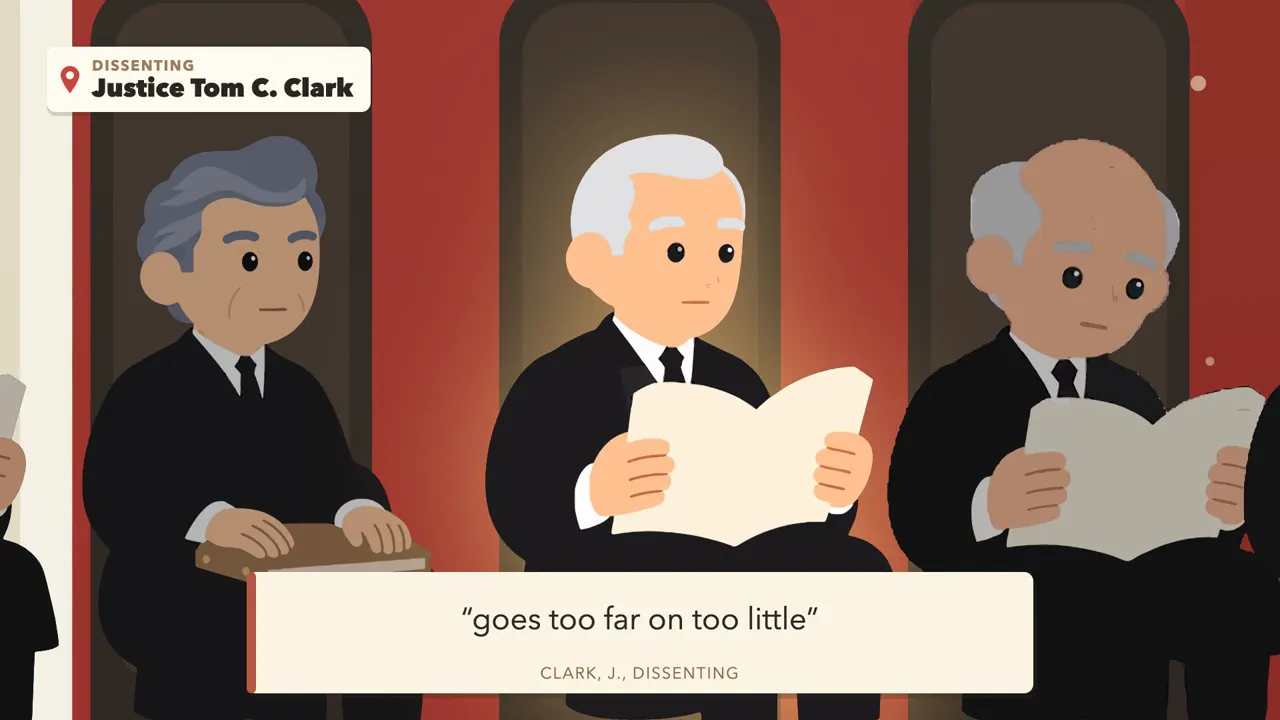
Justice Clark (dissenting in Nos. 759–761; concurring in the result in No. 584): "I am unable to join the majority because its opinion goes too far on too little, while my dissenting brethren do not go quite far enough." (384 U.S. at 499). He would have used a totality test, in which "the burden would be on the State to prove that counsel was knowingly and intelligently waived or that in the totality of the circumstances, including the failure to give the necessary warnings, the confession was clearly voluntary." (at 503).
Justice Harlan, joined by Stewart and White: "I believe the decision of the Court represents poor constitutional law and entails harmful consequences for the country at large." (at 504). "The social costs of crime are too great to call the new rules anything but a hazardous experimentation." (at 517).
Justice White, joined by Harlan and Stewart: the rule "has no significant support in the history of the privilege or in the language of the Fifth Amendment." (at 526). "In some unknown number of cases the Court's rule will return a killer, a rapist or other criminal to the streets and to the environment which produced him, to repeat his crime whenever it pleases him." (at 542).
Doctrine map
| Stage | Case | What it added |
|---|
| Coerced confessions (due process) | Brown v. Mississippi, 297 U.S. 278 (1936) | "The rack and torture chamber may not be substituted for the witness stand." (at 285–286) |
| Counsel at trial | Gideon v. Wainwright, 372 U.S. 335 (1963) | Sixth Amendment trial right; cited in Miranda on indigent suspects (384 U.S. at 473) |
| Counsel in the station house | Escobedo v. Illinois, 378 U.S. 478 (1964) | A requested lawyer denied during accusatory questioning violated the Sixth Amendment, on those facts (at 490–492) |
| Warnings rule | Miranda v. Arizona, 384 U.S. 436 (1966) | Custody + interrogation → warnings and a valid waiver, or the statement is out |
| Impeachment | Harris v. New York, 401 U.S. 222 (1971) | Trustworthy unwarned statements may impeach a testifying defendant (at 224–226) |
| Fruits | Michigan v. Tucker, 417 U.S. 433 (1974); Oregon v. Elstad, 470 U.S. 298 (1985) | Limits on excluding the fruits of unwarned statements (as described in Vega, slip op. at 8–9) |
| Public safety | New York v. Quarles, 467 U.S. 649 (1984) | Questions prompted by a threat to public safety may come before warnings (at 655–657) |
| Constitutional status | Dickerson v. United States, 530 U.S. 428 (2000) | Congress cannot override Miranda by statute (18 U.S.C. § 3501) |
| Physical fruits | United States v. Patane, 542 U.S. 630 (2004) | No suppression of physical evidence found through a voluntary unwarned statement (plurality, at 634–637) |
| Waiver by conduct | Berghuis v. Thompkins, 560 U.S. 370 (2010) | Silence alone does not invoke the right; an understood warning followed by an uncoerced answer can be an implied waiver (at 381–384) |
| Remedies | Vega v. Tekoh, 597 U.S. 134 (2022) | A Miranda violation alone does not support a damages claim under 42 U.S.C. § 1983 |
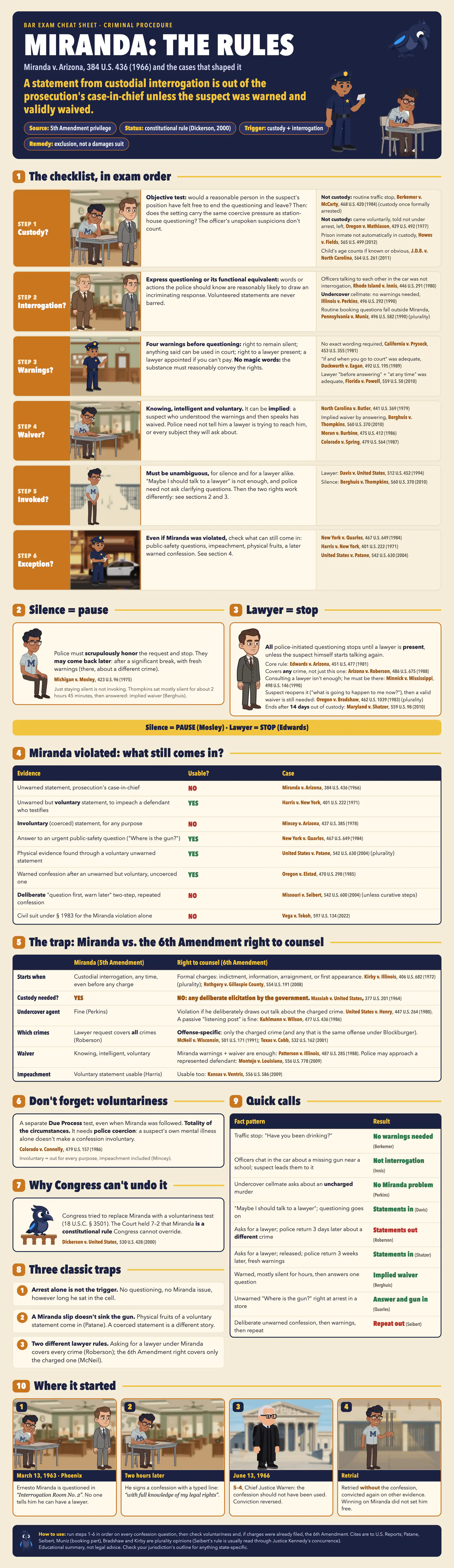
The test. (1) Custody: was the person in custody or "otherwise deprived of his freedom of action in any significant way"? (2) Interrogation: was the questioning "initiated by law enforcement officers"? (3) Warnings: were they given, or a fully effective equivalent? (4) Waiver: voluntary, knowing and intelligent? (5) Invocation: did questioning stop when the person asked for silence or a lawyer? (6) Exceptions: impeachment, public safety, physical fruits, and the limits on remedies.
What happened next
Congress. "Two years after Miranda was decided, Congress enacted § 3501" (530 U.S. at 435). The statute was enacted June 19, 1968 (Pub. L. 90-351) and provides that "a confession, as defined in subsection (e) hereof, shall be admissible in evidence if it is voluntarily given." (18 U.S.C. § 3501(a)). In Dickerson's own case, a divided Fourth Circuit panel held that the statute, not Miranda, controlled (166 F.3d 667 (4th Cir. 1999); described at 530 U.S. at 432).
Dickerson (2000). "We hold that Miranda, being a constitutional decision of this Court, may not be in effect overruled by an Act of Congress, and we decline to overrule Miranda ourselves." (530 U.S. at 432). "Miranda has become embedded in routine police practice to the point where the warnings have become part of our national culture." (at 443). "In sum, we conclude that Miranda announced a constitutional rule that Congress may not supersede legislatively." (at 444). Justice Scalia, dissenting, objected to a claimed power to impose "prophylactic" rules: "That is an immense and frightening antidemocratic power, and it does not exist." (at 446).
Exceptions. Harris: "The shield provided by Miranda cannot be perverted into a license to use perjury by way of a defense, free from the risk of confrontation with prior inconsistent utterances." (401 U.S. at 226). Quarles, a gun hidden in an A & P supermarket (467 U.S. at 652): "We conclude that the need for answers to questions in a situation posing a threat to the public safety outweighs the need for the prophylactic rule protecting the Fifth Amendment's privilege against self-incrimination." (at 657). Patane (plurality): "The Miranda rule is not a code of police conduct, and police do not violate the Constitution (or even the Miranda rule, for that matter) by mere failures to warn." (542 U.S. at 637). Berghuis: "Where the prosecution shows that a Miranda warning was given and that it was understood by the accused, an accused's uncoerced statement establishes an implied waiver of the right to remain silent." (560 U.S. at 384).
Vega v. Tekoh (2022). A sheriff's deputy questioned a hospital worker without warnings. His statement was used at a trial that ended in acquittal, and he then sued under § 1983 (slip op., syllabus at 1). "The question we must decide is whether a violation of the Miranda rules provides a basis for a claim under §1983. We hold that it does not." (slip op. at 4). "Because a violation of Miranda is not itself a violation of the Fifth Amendment, and because we see no justification for expanding Miranda to confer a right to sue under §1983, the judgment of the Court of Appeals is reversed" (slip op. at 16). The majority pointed to suppression at trial as the remaining protection (slip op. at 14–15). Justice Kagan dissented: "It holds that Miranda is not a constitutional right enforceable through a §1983 suit. And so it prevents individuals from obtaining any redress when police violate their rights under Miranda." (dissent, slip op. at 1). "Today, the Court strips individuals of the ability to seek a remedy for violations of the right recognized in Miranda." (id. at 6). Vega left the exclusionary rule in place. Commentators disagree about what it means for Dickerson's "constitutional rule" (see Further reading).
Common myths vs the record
| Myth | Record |
|---|
| Miranda walked free. | He was retried without the confession, convicted, and the conviction was affirmed (104 Ariz. 174). |
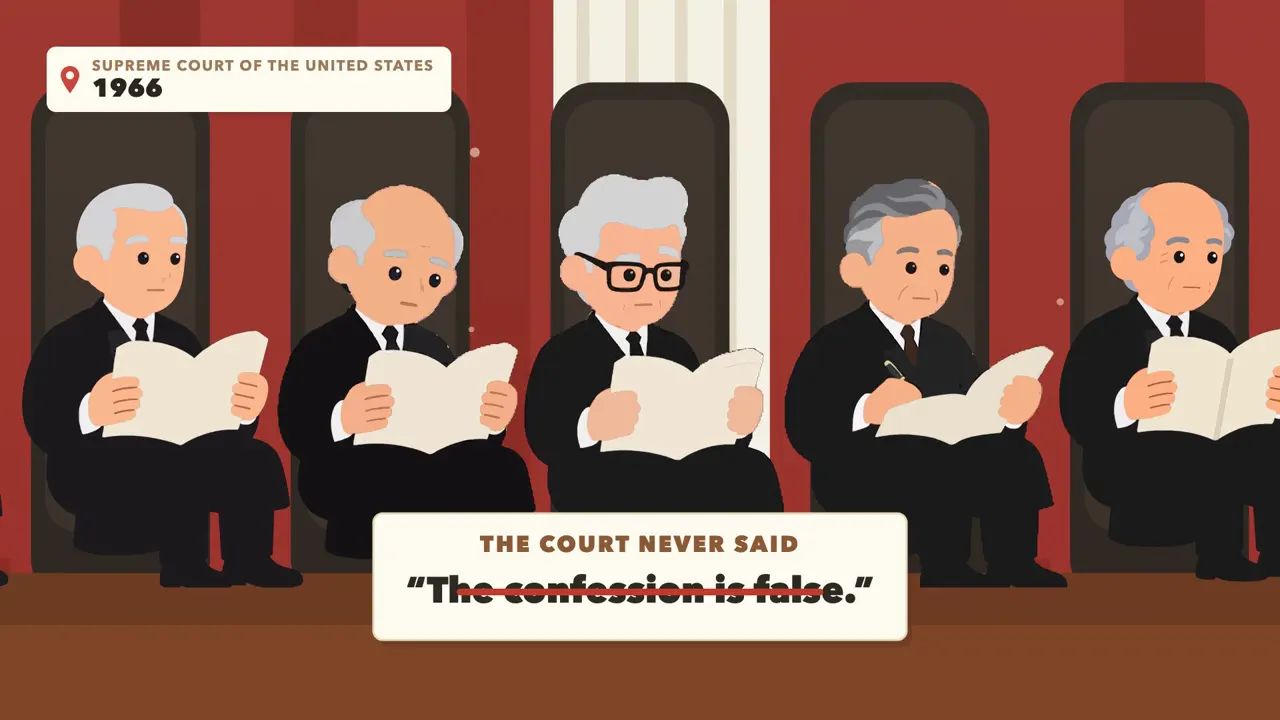
| The Court found him innocent, or found the confession false. | The Court ruled only on admissibility (384 U.S. at 491–492). |
| He never had a lawyer. | Counsel objected for him at trial (384 U.S. at 492), and Alvin Moore argued his appeal (98 Ariz. at 21). The missing lawyer was the one in the interrogation room. |
| No warning means the case is dismissed. | The remedy is exclusion of the statement, with exceptions. Other evidence can still convict, as Miranda's own retrial showed. |
| Police must read you your rights at arrest. | The trigger is custodial interrogation (384 U.S. at 444). Volunteered statements and on-the-scene questioning are not covered (at 477–478). |
| Staying silent invokes your rights. | Invocation must be unambiguous (Berghuis, 560 U.S. at 381–382). |
| You can sue an officer for skipping the warnings. | Not under § 1983 for a Miranda violation alone (Vega, slip op. at 4, 16). |
Study questions
- What are the four warnings, and where does the Court summarize them?
- Define "custodial interrogation." Which two elements must both be present?
- Why did the typed clause on Miranda's statement fail as a waiver?
- How did Arizona read Escobedo in 1965, and why did the Supreme Court disagree?
- How does Justice Clark's dissent differ from Justice Harlan's?
- Why must indigent suspects be told that a lawyer will be appointed?
- How was Miranda convicted again, and why was Mrs. Hoffman's testimony admitted?
- Dickerson calls Miranda a constitutional rule, while Patane and Vega call its rules prophylactic. Can both be right?
- Harris or Quarles: which limits the remedy, and which limits when warnings are required?
- Does Vega weaken Miranda in practice, or only close off one remedy?
Hypothetical A. After a crash, an officer at the roadside asks a driver what happened, and the driver admits drinking. Later, handcuffed at the station and without warnings, the driver is asked again. Which statement does Miranda reach (384 U.S. at 444, 477–478)?
Hypothetical B. After warnings, a suspect sits silent for two hours and then answers one question. At trial he testifies and contradicts that answer. Can the prosecution use the answer in its main case? To impeach him (Berghuis; Harris)?