Verified Docket
Case notes
Study notes for Liebeck v. McDonald’s: the case card, facts, procedure, holding, reasoning, separate opinions, what came next and study questions. Sources are listed at the end of the page.
Case card
| Field | Record |
|---|
| Case name | Stella Liebeck v. McDonald's Restaurants, P.T.S., Inc. (McDonald's Corporation added as a defendant by amended complaint; P.T.S., Inc., the local franchisee, was dismissed before the case went to the jury) [S1] |
| Citation | Liebeck v. McDonald's Restaurants, P.T.S., Inc., No. CV-93-02419, 1995 WL 360309 (N.M. Dist. Ct., Bernalillo County, 1994) [S1]. There is no official or regional reporter citation: no appellate court ever issued an opinion. The Westlaw number is a database identifier, not a reporter. |
| Court | Second Judicial District Court of New Mexico, Bernalillo County (Albuquerque) — a state trial court [S1] |
| Judge | Hon. Robert H. Scott, District Judge [S1, S4] |
| Parties' counsel | Plaintiff: S. Reed Morgan (Texas), Jerry R. McKenney, and local counsel Kenneth R. Wagner (Albuquerque). Defendant: Rodey, Dickason, Sloan, Akin & Robb, P.A. (Albuquerque), including Tracy McGee [S1, S3] |
| Filed | Original complaint filed 21 March 1993 [S1] |
| Tried | 8–12 and 15–17 August 1994 [S1] |
| Verdict | 17 August 1994 (Retro Report: "Wednesday, August 17th") [S5]. Note: the Westlaw entry is reported with a date of 14 August 1994 [S1], which falls before the verdict and is likely a database or transcription error; other secondary accounts give 18 August. We use 17 August and flag the conflict. |
| Jury | Twelve jurors, six men and six women [S1, S3] |
| Vote | Not applicable (trial court; no appellate panel). |
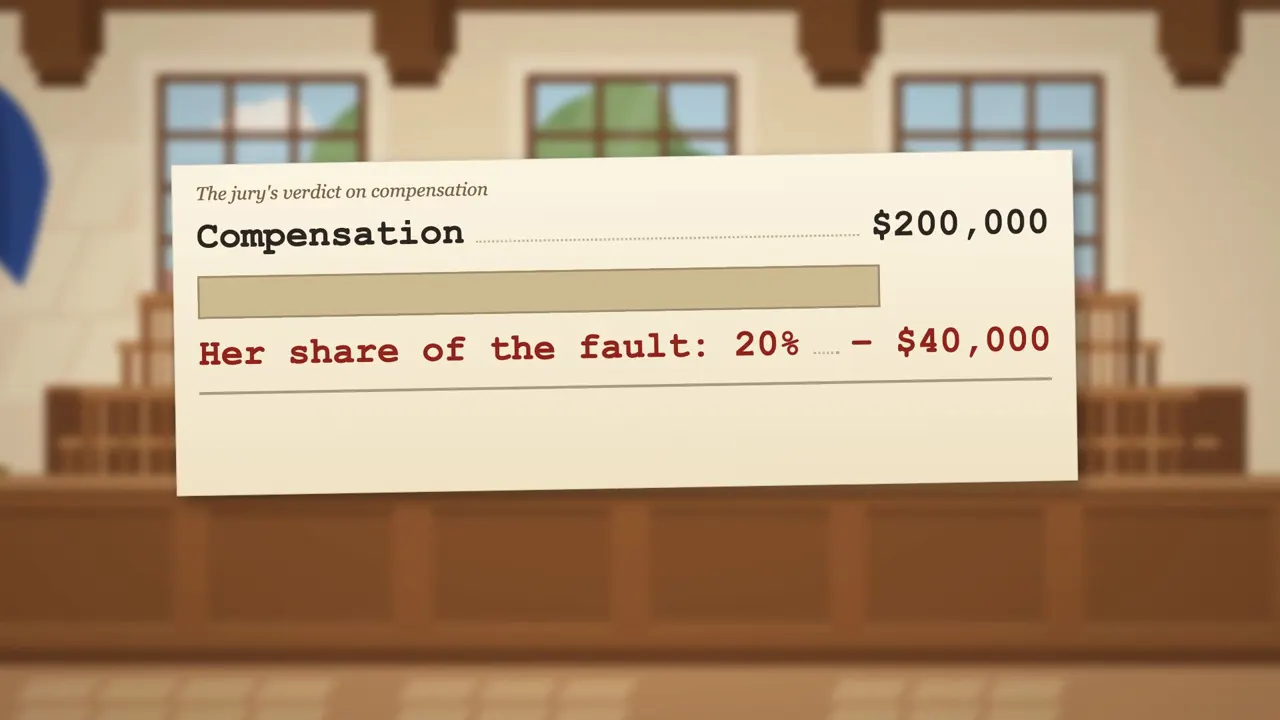
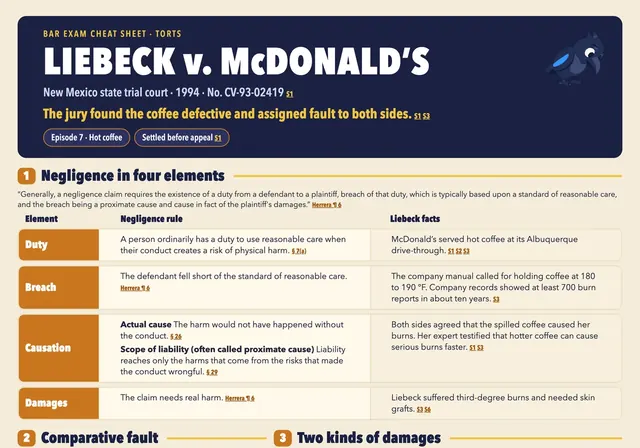
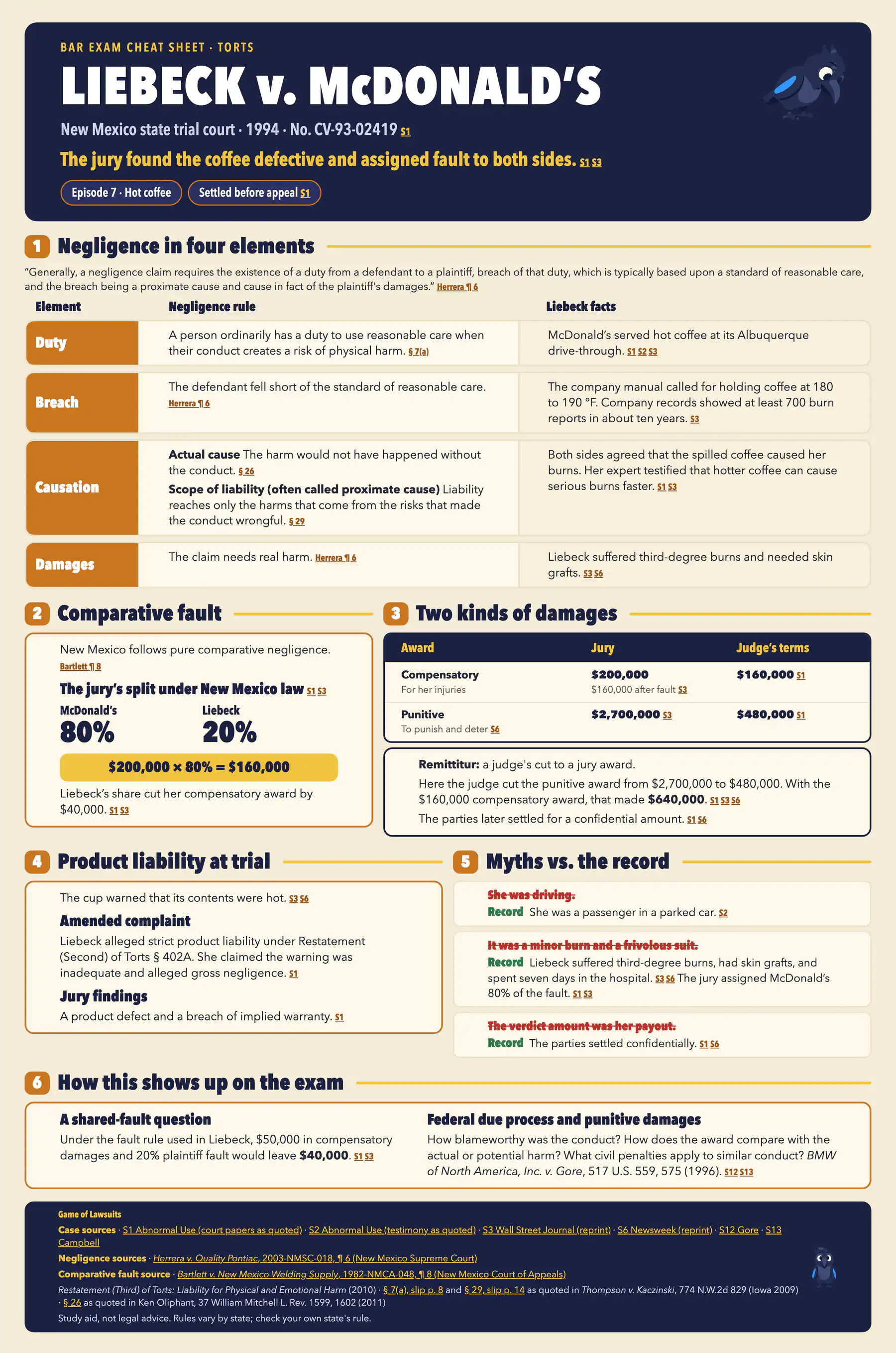
| Verdict figures | Compensatory damages $200,000, reduced by 20% for Ms. Liebeck's comparative fault to $160,000; punitive damages $2,700,000 [S1, S3, S4] |
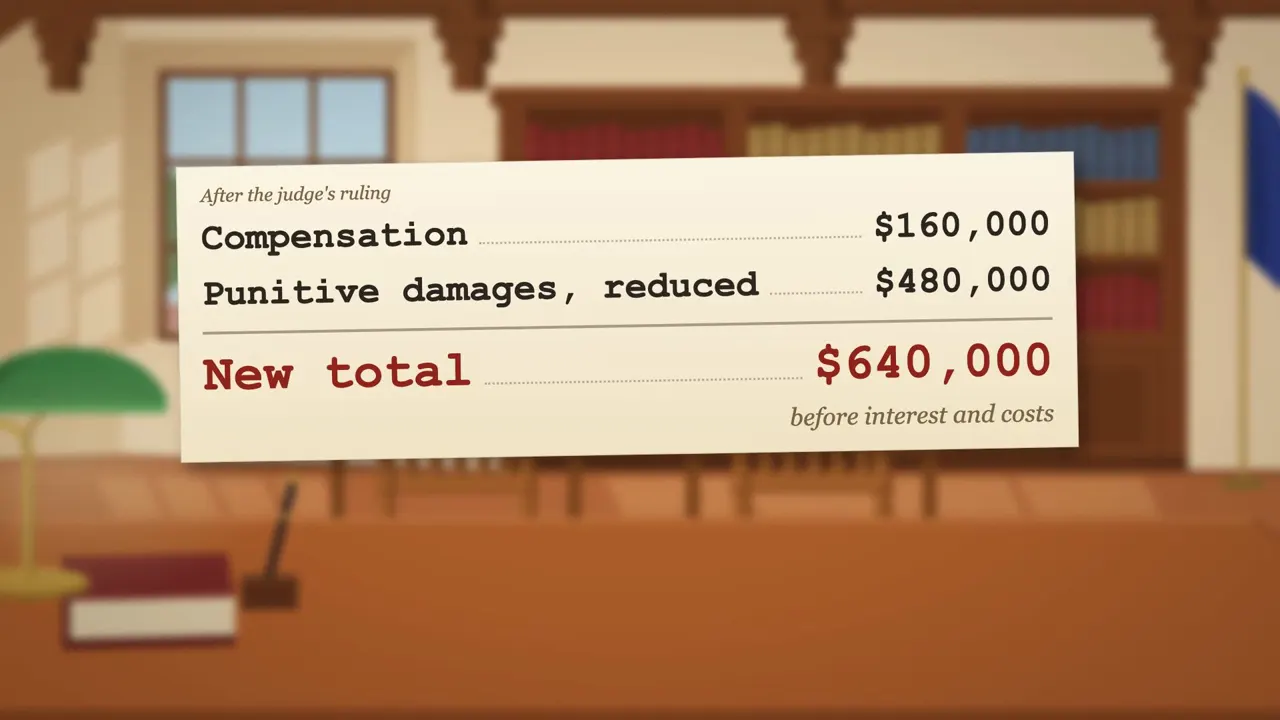
| Post-trial ruling | September 1994: new trial ordered unless the plaintiff accepted a remittitur of punitive damages to $480,000 (three times $160,000), for a total of $640,000 [S1, S4] |
| Final outcome | Judgment vacated 28 November 1994; confidential settlement, reported in the press in early December 1994. Amount never made public [S1, S4] |
| Outcome in one line | A jury found McDonald's coffee defectively dangerous and McDonald's 80% at fault; the judge cut the punitive award by about 82%; the parties then settled privately. |
The story in 150 words
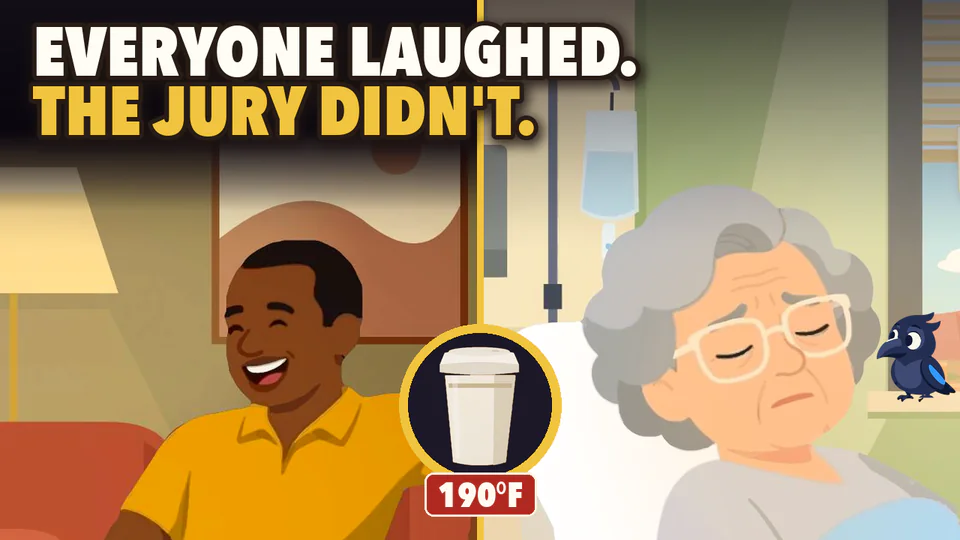
In February 1992, Stella Liebeck, 79, was a passenger in her grandson's car in Albuquerque. He had parked after buying breakfast at a McDonald's drive-through so she could add cream and sugar to her coffee. With nowhere flat to set the cup, she held it between her knees, pulled at the lid, and the coffee spilled into her lap. She suffered third-degree burns and needed skin grafts.
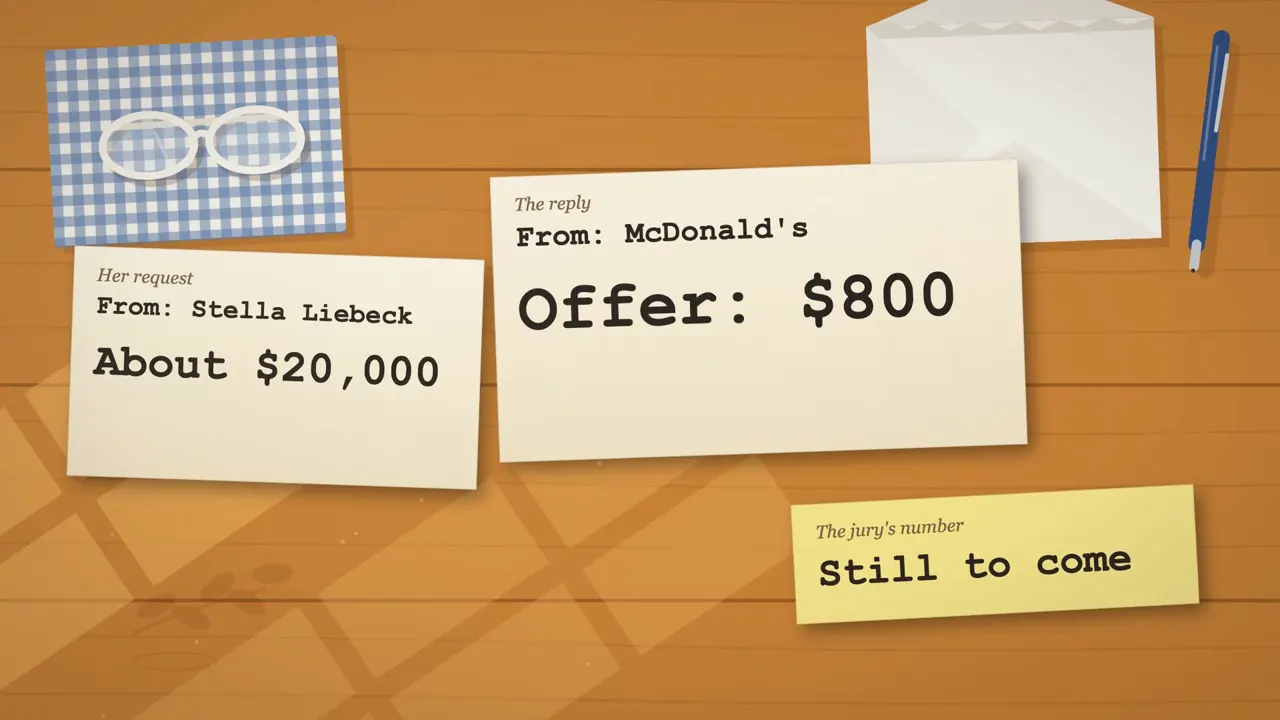
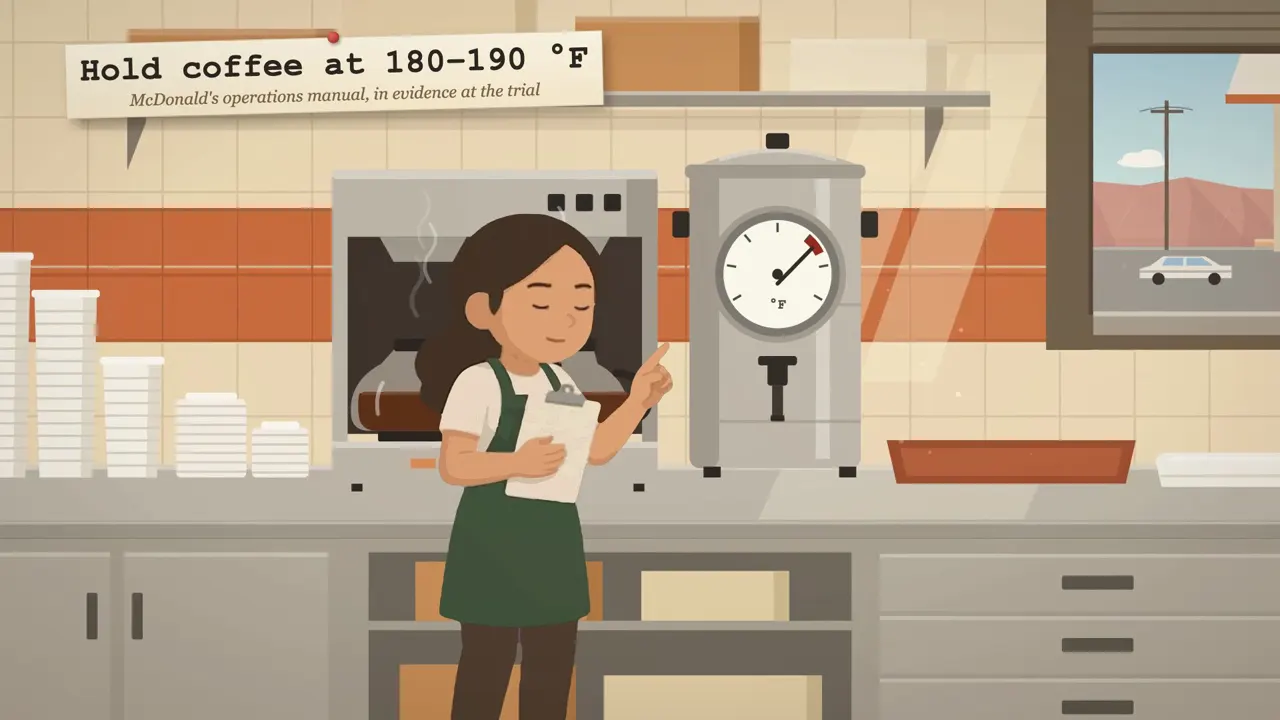
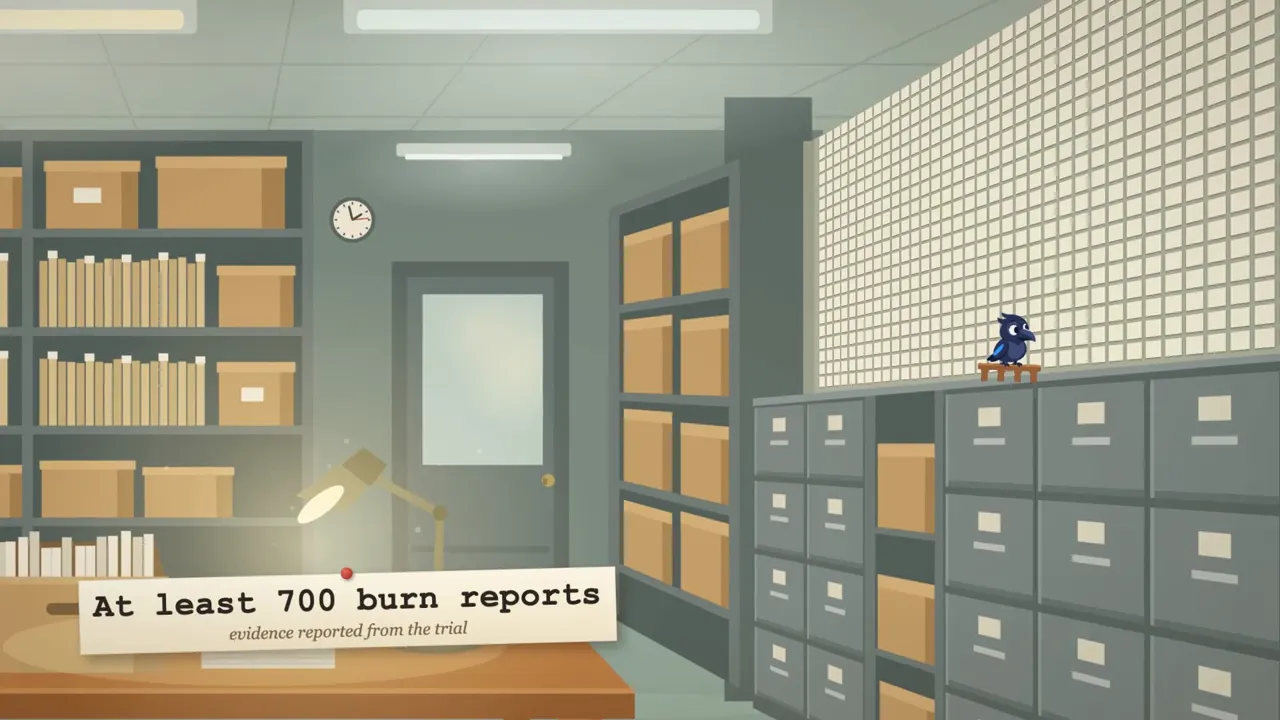
Her family asked McDonald's to cover her costs and to check its coffee temperature. McDonald's offered $800. At trial in 1994 the jury heard that McDonald's required coffee to be held at 180–190 °F and had received at least 700 burn reports in about ten years. It found the coffee defective, held Ms. Liebeck 20% responsible, and added $2.7 million in punitive damages. The judge cut that to $480,000. The parties then settled confidentially. The public mostly heard only the first number.
Facts
Because no court wrote an opinion finding facts, the "facts" here are (a) what the pleadings alleged, (b) what witnesses testified to, as reported, and (c) what the jury's verdict necessarily decided. Pin references are to the sections of the sources in SOURCES.md.
The spill.
- On 27 February 1992 Ms. Liebeck, then 79, was in the passenger seat of her grandson Chris Tiano's 1989 Ford Probe. They bought breakfast at the McDonald's drive-through at 5001 Gibson Blvd. S.E., Albuquerque [S1, "Where was the McDonald’s franchise in question?"; S2, ¶ 4].
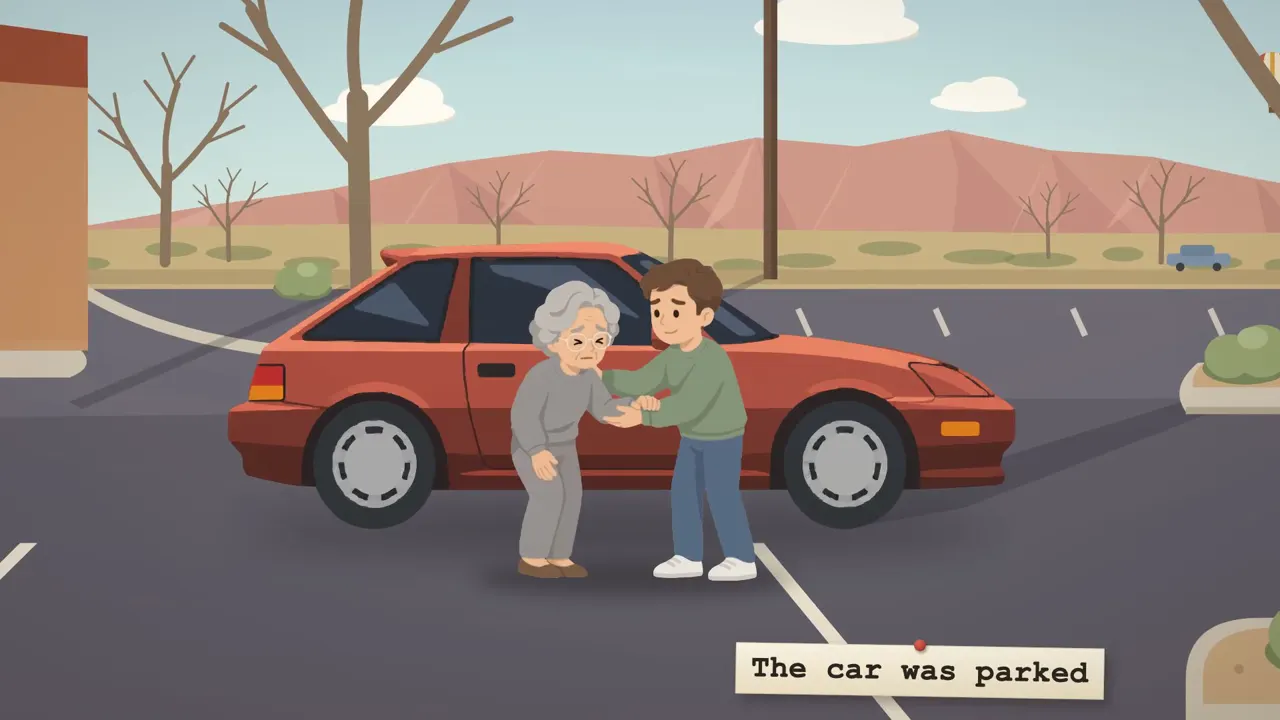
- The car was parked: her grandson testified he drove to a parking space, and she testified he parked "so [she] could put cream in [her] coffee" [S2, ¶ 5].
- She testified that she "couldn’t hold it, so [she] put it between [her] knees and tried to get the top off that way" (as quoted by S2, ¶ 6; Newsweek quotes the same testimony in a slightly different form, S6). The lid came away and the coffee spilled into her lap [S2, ¶ 6].
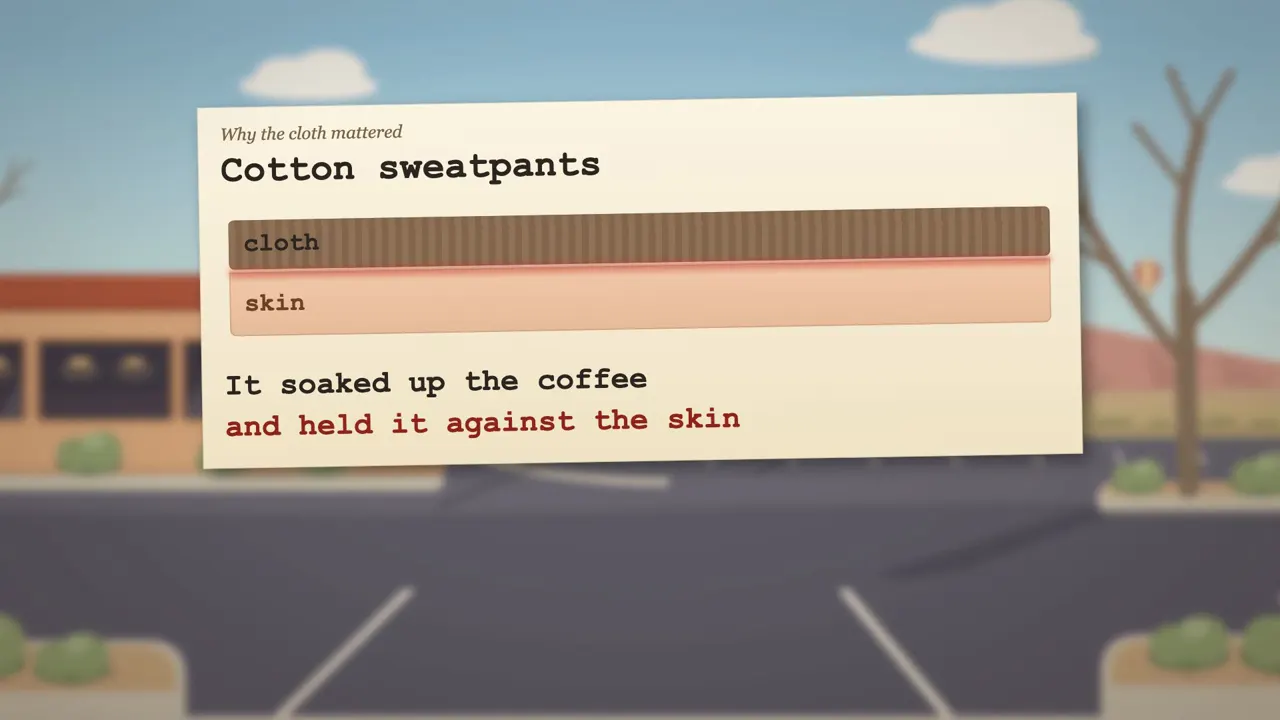
- She was wearing sweatpants (CAOC [S8]; Retro Report [S5] says "sweat suit"), which held the coffee against her skin.
The injuries (described non-graphically).
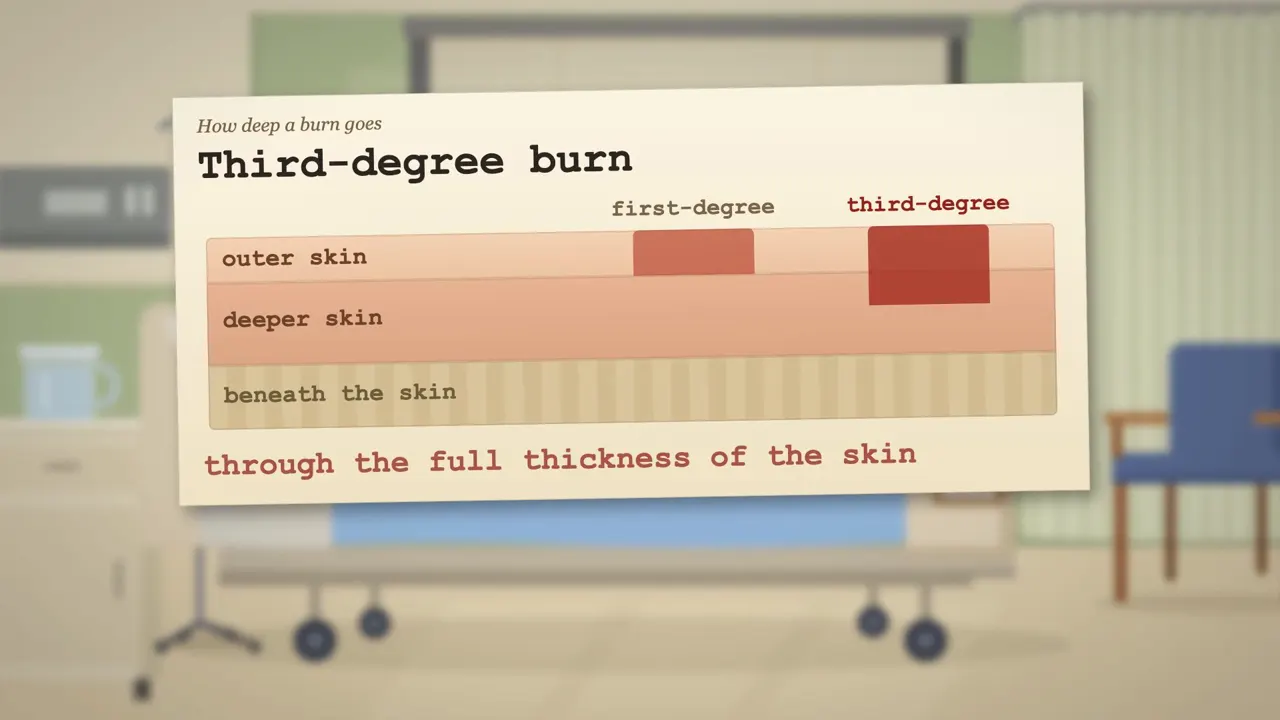
- The amended complaint alleged second- and third-degree burns to the lower body requiring skin grafting [S1, "What damages were alleged in the amended complaint?"]. The WSJ reported third-degree burns of the groin, inner thighs and buttocks, seven days in hospital, and skin grafts [S3].
- The treating physician testified that about 6% of her body was burned, most of it third-degree [S1, "Who were the testifying experts?"]. Retro Report quotes her daughter giving different percentages [S5]. Burn-area figures differ between sources; this pack does not rely on them.
The coffee.
- McDonald's operations and training manual said coffee must be brewed at 195–205 °F and held at 180–190 °F "for optimal taste" (WSJ's summary of the manual produced before trial) [S3].
- A defense law clerk's 1993 survey of local restaurants found none within about 20 °F of McDonald's serving temperature (WSJ) [S3; S1, "What was the basis of the McDonald’s motion for summary judgment?" ¶¶ 9–13].
- The cups carried a warning that the contents were hot [S3; S6 ("CAUTION: CONTENTS HOT")].
Prior burn reports.
- Company documents showed that "in the past decade McDonald's had received at least 700 reports of coffee burns ranging from mild to third-degree, and had settled claims arising from scalding injuries for more than $500,000" (WSJ) [S3]. Retro Report gives the period as 1983–1992 and the figure as "nearly 700" [S5].
Pre-trial settlement attempts.
- The family asked McDonald's to check its coffee temperature and to cover costs; McDonald's offered $800 [S3; S5; S6].
- The size of the initial request differs between sources: $20,000 to cover medical costs and lost income (CAOC, TIME, Abnormal Use citing the WSJ) [S8; S9; S1], versus "out-of-pocket expenses — about $2,000 — plus the lost wages of her daughter" (Newsweek) [S6]. The amended complaint pleaded past and future medical expenses of about $12,500 [S1].
- Before trial, plaintiff's counsel offered to settle for $300,000; a court-ordered mediator recommended $225,000; McDonald's declined [S3; S6].
Procedural history
| Date | Court / event | What happened | Source |
|---|
| 27 Feb 1992 | — | Spill and injury in Albuquerque | S1, S2 |
| Aug 1992 | — | Letter to McDonald's asking it to lower the temperature and cover costs; $800 offered | S6 |
| 21 Mar 1993 | 2d Jud. Dist. Ct., Bernalillo County | Complaint filed against franchisee P.T.S., Inc.; amended complaint later adds McDonald's Corporation, pleading strict product liability (citing Restatement (Second) of Torts § 402A), negligence, breach of implied warranty and punitive damages | S1 |
| 21 Jan 1994 | same | Defendants' summary-judgment motion; denied | S1 |
| 29 Jul 1994 | same | Plaintiff's motion for partial summary judgment on liability denied by letter decision; parties stipulate that the coffee caused the burns | S1 |
| Aug 1994 | same | Court-ordered mediation; mediator recommends $225,000; McDonald's declines | S3 |
| 8–17 Aug 1994 | same (jury trial) | Verdict for plaintiff: product defect and breach of implied warranty; plaintiff 20% at fault; $200,000 compensatory (→ $160,000); $2.7 million punitive | S1, S3, S5 |
| 29 Aug 1994 | same | McDonald's post-trial motions (new trial; judgment notwithstanding the verdict) | S1 |
| Early Sept 1994 | same | Judge Scott appoints retired N.M. Supreme Court Justice William F. Riordan to mediate | S1 (citing AP, 2 Sept 1994) |
| Mid-Sept 1994 | same | New trial / JNOV denied; punitive damages held excessive; remittitur to $480,000 or new trial | S1 (order dated 16 Sept 1994; AP coverage dated 15 Sept 1994) |
| Oct 1994 | N.M. Supreme Court | Reported to have declined Ms. Liebeck's challenge to the remittitur | S1 (citing Chicago Tribune, 14 Oct 1994) |
| 3 Nov 1994 | 2d Jud. Dist. Ct. | Plaintiff's motion to reconsider remittitur denied | S1 |
| 28 Nov 1994 | same | Judgment vacated | S1 |
| ~1–2 Dec 1994 | — | Confidential settlement reported | S1 (citing Houston Chronicle, 2 Dec 1994) |
No court above the trial court ever ruled on the merits. A 1998 federal appeals court, discussing coffee-burn cases generally, put it this way: the New Mexico suit "produced a widely publicized jury verdict of some $3 million but not a published opinion (the case was settled before appeal)" [S10, ¶ 6].
The questions presented
At trial (as framed by the pleadings and the verdict form described in S1):
- Was McDonald's coffee, served at the temperature McDonald's specified, a defective and unreasonably dangerous product, including through an inadequate warning?
- Did McDonald's breach the implied warranty of fitness?
- Under New Mexico's comparative-fault system, how should fault be divided between McDonald's and Ms. Liebeck?
- Was McDonald's conduct willful, reckless, malicious or wanton, so that punitive damages were available, and if so, how much?
After trial: 5. Was the $2.7 million punitive award excessive as a matter of law?
The holding and the rule
The jury found for Ms. Liebeck on product defect and breach of implied warranty, and found her 20% at fault [S1]. The WSJ reported that the jury "found that McDonald's had engaged in willful, reckless, malicious or wanton conduct, the basis for punitive damages" [S3].
The trial judge's post-trial order (quoted in S1; we have not seen the order itself):
"The award of punitive damages of 2.7 million dollars was excessive, as a matter of law. Accordingly, a new trial shall be granted on all issues unless Plaintiff accepts — by written notice to the Court within 25 days of the date of entry of this Order – a remittitur of the punitive damages award as hereby directed by the Court." [S1, "What became of the verdict?"]
"The remittitur, if accepted, shall reduce the punitive damages award to $480,000, which represents the trebling of the $160,000 award of compensatory damages." [S1, same]
The same order stated that "the compensatory award of $160,000 shall not be disturbed" [S1].
Rule illustrated. A jury may find both the seller and the injured buyer at fault and reduce compensation by the buyer's share. Punitive damages require a separate finding of aggravated conduct. A trial judge who thinks a punitive award is excessive may offer a remittitur: the plaintiff accepts a reduced award or faces a new trial.
The reasoning
There is no written opinion explaining the verdict. What we have is (a) the judge's reported remarks and (b) jurors' post-trial interviews.
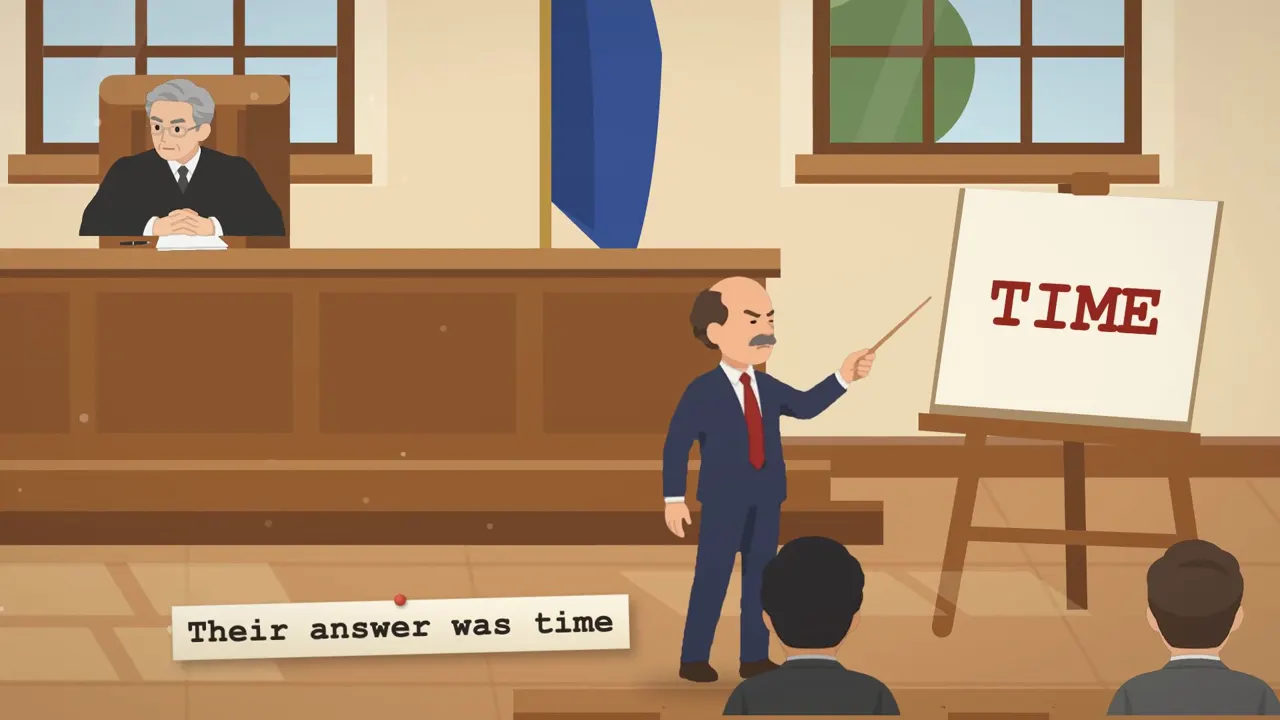
Step 1 — Temperature mattered because of time. McDonald's expert said any coffee hotter than 130 °F could cause third-degree burns, so the exact temperature did not matter. Ms. Liebeck's medical expert answered that lowering the temperature mattered because the time needed to cause a serious burn rises steeply as the temperature falls [S3]. The WSJ reported:
"it takes less than three seconds to produce a third-degree burn at 190 degrees, about 12 to 15 seconds at 180 degrees and about 20 seconds at 160 degrees." [S3— WSJ paraphrase of testimony]
These seconds are reported testimony, and other sources give different figures (S6 reports Dr. Baxter on second-degree burns at 170 °F). We report them as testimony, not as settled science.
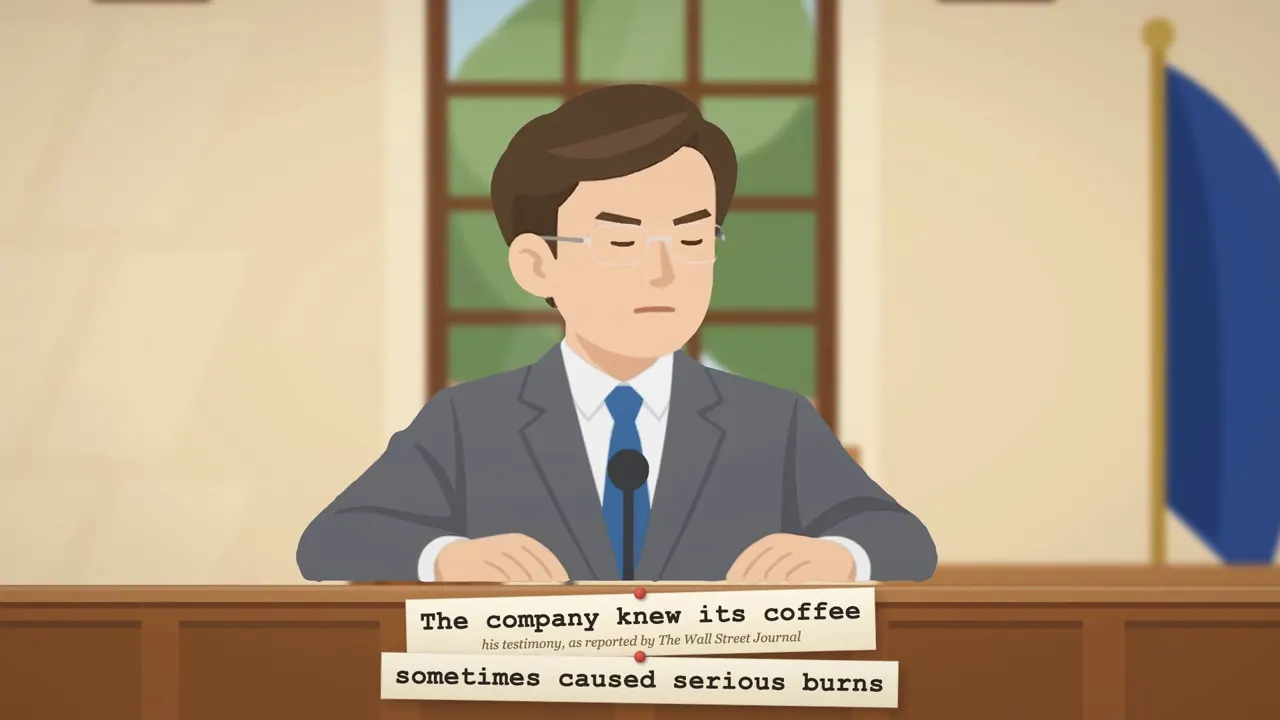
Step 2 — The company knew. The quality-assurance manager, Christopher Appleton, "testified that McDonald's knew its coffee sometimes caused serious burns but hadn't consulted burn experts about it," and that it did not intend to change its coffee policies, saying: "There are more serious dangers in restaurants." [S3]
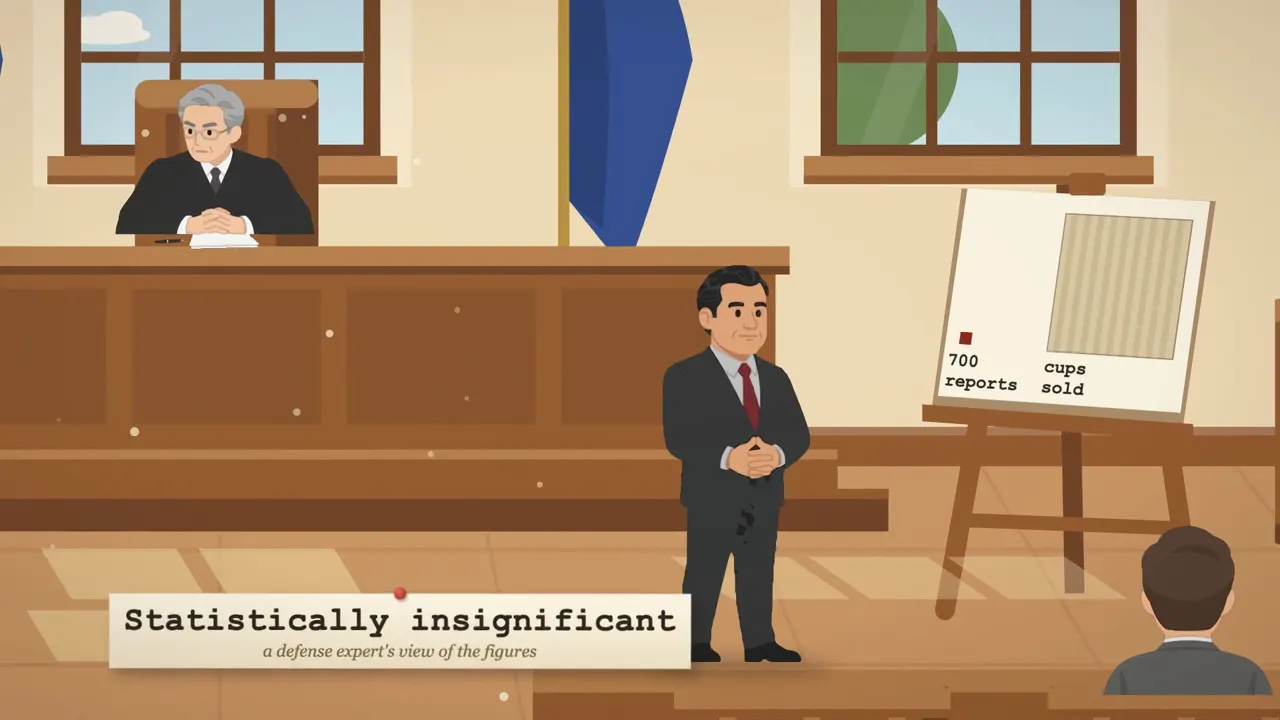
Step 3 — Numbers versus people. A defense human-factors expert told the jury hot-coffee burns were "statistically insignificant" compared with the cups sold [S3]; Newsweek quotes him as calling them "basically trivially different from zero" [S6]. Juror Betty Farnham told the WSJ:
"There was a person behind every number, and I don't think the corporation was attaching enough importance to that." [S3]
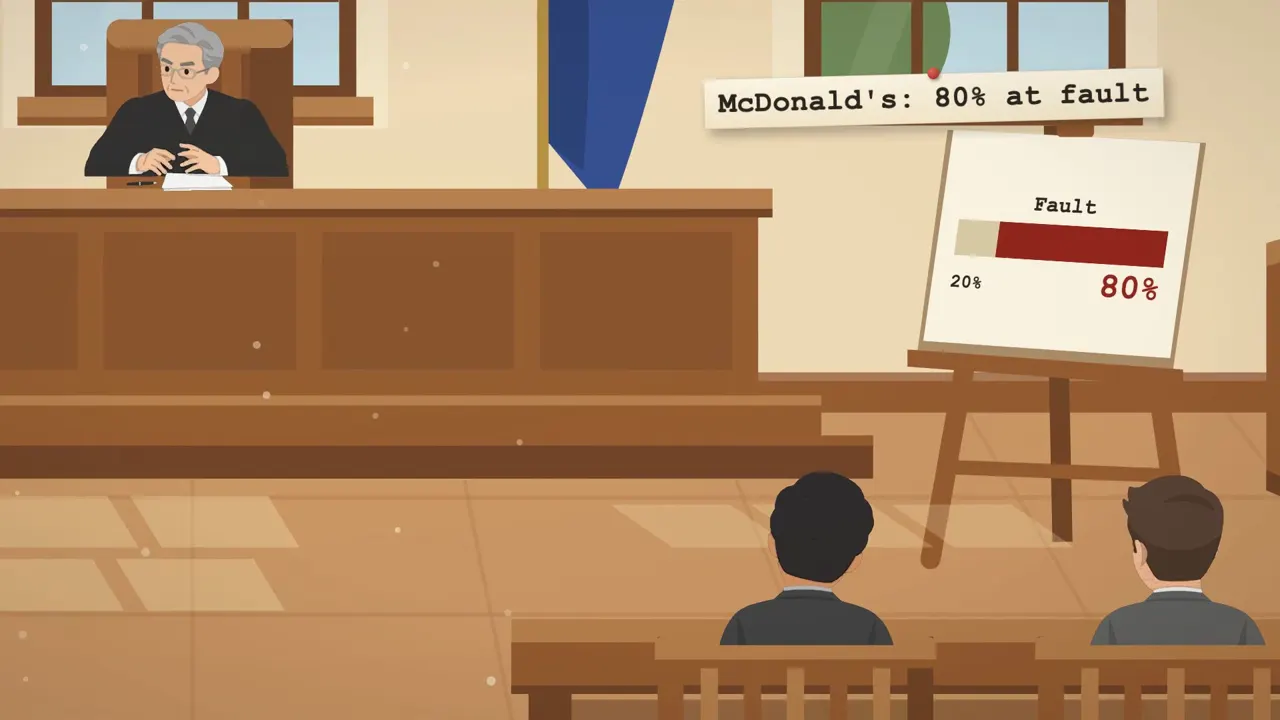
Step 4 — Shared fault. McDonald's argued that Ms. Liebeck contributed to her injuries by holding the cup between her legs and not removing her clothing immediately [S3]. The jury agreed in part and assigned her 20% [S1; S3].
Step 5 — Why $2.7 million. Plaintiff's counsel suggested punishing McDonald's by one to two days of company-wide coffee sales, which he estimated at $1.35 million a day; some jurors argued for as much as $9.6 million; the jury settled on $2.7 million [S3]. These are sales (revenue) figures, not profit.
Step 6 — The judge's view. Judge Scott reduced the punitive award to three times compensatory damages. As reported, he still described McDonald's conduct as "willful, wanton, reckless" and "callous" (AP, as quoted in S1), and told Newsweek the case was "not a runaway. I was there." [S6]. Newsweek reported that he wanted to show it "was appropriate to punish and deter" McDonald's coffee policy [S6].
Concurrences and dissents
None. This was a jury trial in a state trial court. No appellate opinion, concurrence or dissent exists.
Doctrine map
| Doctrine | Key test / element | How Liebeck fits | Leading authority (full citation) |
|---|
| Strict products liability | A seller of a product "in a defective condition unreasonably dangerous" is liable for physical harm it causes | The complaint pleaded this rule and the jury found the coffee defective | Restatement (Second) of Torts § 402A (1965), as pleaded in the amended complaint [S1] |
| Consumer-expectations test | Is the danger greater than the ordinary consumer, with ordinary community knowledge, would expect? | Plaintiff's core theory: people know coffee is hot, not that it can cause full-thickness burns in seconds | Indiana's statutory version is quoted in McMahon v. Bunn-O-Matic Corp., 150 F.3d 651 (7th Cir. 1998) [S10, ¶ 16] |
| Risk-utility / design defect | Do the benefits of the design (taste, holding time) outweigh its risks? | McDonald's argued that customers wanted hot coffee and that the temperature matched industry practice | McMahon, 150 F.3d 651, rejected a coffee-maker design claim for lack of evidence on costs and benefits [S10, ¶¶ 18–19] |
| Failure to warn | Was the warning adequate for a non-obvious, serious danger? | A "contents hot" label was on the cup; the jury had to decide whether it was enough | McMahon, 150 F.3d 651 [S10, ¶¶ 8, 13–14], citing Restatement (Third) of Torts: Products Liability § 2 cmt. j (Proposed Final Draft 1997) |
| Comparative fault | Damages reduced by the plaintiff's own share of fault | 20% to Ms. Liebeck; $200,000 → $160,000 | New Mexico applies comparative fault (reflected in the verdict) [S1, S3] |
| Punitive damages | Aggravated conduct (willful, wanton, reckless, malicious); amount must be proportionate | $2.7M by jury; remitted to $480,000 (3:1 ratio) | BMW of North America, Inc. v. Gore, 517 U.S. 559 (1996) [S12]; State Farm Mut. Auto. Ins. Co. v. Campbell, 538 U.S. 408 (2003) [S13] |
| Remittitur | Judge may offer a reduced award as the alternative to a new trial | Used here | Trial court order [S1] |
Before and after Liebeck. Coffee-burn claims usually failed. In McMahon the Seventh Circuit listed several defense rulings, including Huppe v. Twenty-First Century Restaurants of America, Inc., 130 Misc. 2d 736, 497 N.Y.S.2d 306 (N.Y. Sup. 1985), Greene v. Boddie-Noell Enterprises, Inc., 966 F. Supp. 416 (W.D. Va. 1997) and Barnett v. Leiserv, Inc., 968 F. Supp. 690 (N.D. Ga.), aff'd, 137 F.3d 1356 (11th Cir. 1998). It also noted one contrary ruling, Nadel v. Burger King Corp., 119 Ohio App. 3d 578, 695 N.E.2d 1185 (1997), which held that such a claim could go to trial [S10, ¶ 6; citations as given in that opinion].
The Seventh Circuit's own view:
"Bunn can't deliver a medical education with each cup of coffee." [S10, ¶ 13]
"It expects consumers to educate themselves about the hazards of daily life--of matches, knives, and kitchen ranges, of bones in fish, and of hot beverages--by general reading and experience" [S10, ¶ 14 — describing Indiana law]
Punitive-damages ratios. Two years after Liebeck, the Supreme Court held that the Due Process Clause limits punitive awards. Gore identified three guideposts, beginning with reprehensibility: "Perhaps the most important indicium of the reasonableness of a punitive damages award is the degree of reprehensibility of the defendant's conduct." [S12, Part III-A]. Campbell added that "in practice, few awards exceeding a single-digit ratio between punitive and compensatory damages, to a significant degree, will satisfy due process." [S13, Part III]. Judge Scott's 3:1 remittitur came before both cases. The jury's original award was about 17:1 against the $160,000 compensatory figure, which is our own arithmetic, not a court finding.
What happened next
- Settlement. The judgment was vacated on 28 November 1994, and a confidential settlement was reported in early December [S1].
- The temperature. One day after the verdict, a local reporter measured coffee at the same restaurant at 158 °F (WSJ) [S3]. Retro Report (2013) said McDonald's franchisee handbooks now call for coffee "ten degrees lower" [S5]. McDonald's did not respond to Retro Report, so this is not a company statement.
- Congress. In the March 1995 House debate on the Common Sense Legal Reforms Act (part of the "Contract with America"), the case was invoked on both sides. Rep. John Bryant (Tex.), opposing the bill, said on the floor: "McDonald's was warned 700 times by complaints from people saying they had been burned by this super-heated coffee." [S11a, 141 Cong. Rec. H2877 (daily ed. Mar. 8, 1995)]. He returned to it the next day [S11b, H2907–08 (Mar. 9, 1995)]. Newsweek reported that the American Tort Reform Association used the case in radio ads [S6].
- Later coffee cases. McMahon v. Bunn-O-Matic Corp., 150 F.3d 651 (7th Cir. 1998), affirmed summary judgment against a burned coffee drinker [S10, ¶ 21].
- Culture and memory. The case became the standard "frivolous lawsuit" example. Retro Report traced how a 697-word local story shrank to as few as 48 words in some papers [S5]. The 2011 documentary Hot Coffee revisited it [S1; S7].
- The people. Stella Liebeck died on 5 August 2004, aged 91 [S1; S5; S7; S9]. Judge Scott later became a U.S. Magistrate Judge in New Mexico (Abnormal Use, 2011) [S1].
Common myths vs the record
| Myth | Record |
|---|
| "She was driving." | She was the passenger, and the car was parked [S2, ¶¶ 4–5; S5; S6]. |
| "It was just a minor spill." | Third-degree burns, a hospital stay and skin grafts [S1; S3; S6]. |
| "She got rich: $2.9 million." | The jury's $2.86M ($160k + $2.7M) was cut to $640,000 and then replaced by a confidential settlement [S1; S6]. |
| "She was greedy from the start." | The family first asked for costs (figures differ: about $20,000 or about $2,000 plus lost wages) and for a temperature check. McDonald's offered $800 [S3; S6; S8]. |
| "The jury ignored her own fault." | The jury found her 20% at fault and cut her compensation [S1; S3]. |
| "Everyone's coffee is that hot." | Disputed at trial. A defense survey found local coffee about 20 °F cooler (WSJ) [S3]. McDonald's and an industry group said it met industry standards [S3]. In 1998 the Seventh Circuit noted that other courts had reported an industry standard of 175–185 °F [S10, ¶ 8]. |
| "It was a first-time freak accident." | There were at least 700 earlier burn reports in about a decade [S3]. |
| "Juries hand out money on a whim." | The judge reviewed and reduced the award, and later called it "not a runaway" [S1; S6]. |
Study questions
- Where and when was the case tried, and why is there no appellate opinion?
- What is the difference between compensatory and punitive damages? Use the Liebeck figures.
- How did comparative fault change Ms. Liebeck's compensatory award?
- What is a remittitur, and what choice did it give Ms. Liebeck?
- Why did the plaintiff's expert focus on time to injury rather than whether coffee can burn at all?
- How did each side use the 700 prior burn reports?
- The jury based its punitive figure on two days of coffee revenue. Is revenue the right yardstick for punishment? What would profit, or a ratio to harm, measure instead?
- Compare McMahon v. Bunn-O-Matic Corp. with the Liebeck verdict. Is the difference about the law (Indiana vs New Mexico), the defendant (machine maker vs seller), the evidence, or the decision-maker (judge vs jury)?
- After BMW v. Gore and State Farm v. Campbell, would a 17:1 punitive ratio survive today? Would the 3:1 remittitur?
- Why do short news summaries of jury verdicts tend to distort them? What did the 697 → 48 word compression leave out?
Hypothetical A. A café serves tea at 200 °F in a ceramic mug at a table. A customer knocks it over and suffers third-degree burns. The menu has no warning. Apply consumer-expectations and risk-utility analysis. Does the setting (table vs car, mug vs foam cup) change your answer?
Hypothetical B. A chain receives 1,000 burn reports in ten years from 10 billion drinks sold. An internal memo says lowering the temperature by 15 °F would "hurt taste scores". A jury awards $50,000 compensatory and $5 million punitive damages. Analyse reprehensibility, ratio and comparable penalties under Gore.